Posts tagged as:

still life photography

Alla_Mirovskaya_photography

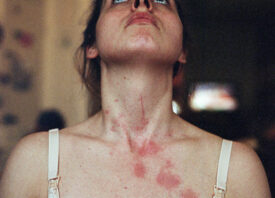
I want to sense the warmth of her heart anew, like in my childhood; to look closer and get to know my present, mature mother. To fixate, to remember, to feel acutely the moments of the life that I treasure, which is primordially a source of my own. Wise and not so wise, powerful and weak, young and mature, good and bad—anything she may be. My mom. Distant no more. Close…again.
Alla Mirovskaya

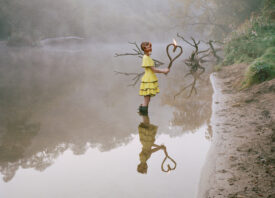
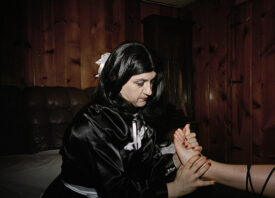
Driven by an inner motivation to comprehend her family reality, Russian photographer Alla Mirovskaya explores the complex relationship between mother and daughter in Distant and Close, a series that reads just like it sounds. She weaves together an intimate narrative through nostalgic, light-soaked images that explore identity, personality and kinship. Mirovskaya spent a year working on the project, navigating the waters of the familial great divide and connection—a documentary process she says prompted a rediscovery of her own worldview.

Alla_Mirovskaya_photography

Alla_Mirovskaya_photography

Alla_Mirovskaya_photography

Alla_Mirovskaya_photography

Alla_Mirovskaya_Photography

Alla_Mirovskaya_Photography

Alla_Mirovskaya_Photography

Alla_Mirovskaya_Photography

Alla_Mirovskaya_Photography

Alla_Mirovskaya_Photography

Lisa_Gonzalez_Photography

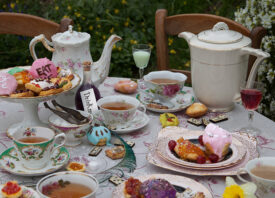
Housewives is New York-based photographer Lisa Gonzalez’s series that recalls society’s expectation of the post-war American housewife. Modeled after advertisements geared towards women in the 1940s, 50s and 60s, Gonzalez’s still life images explore the relationship between consumerism and domesticity of the time. The images have a slightly Stepford-wife feel to them, perfectly put together and pretty as a picture, channeling the visual culture of a time when women were led to believe they were destined for domestic labor.

Lisa_Gonzalez_Photography

Lisa_Gonzalez_Photography

Lisa_Gonzalez_Photography

Lisa_Gonzalez_Photography

Lisa_Gonzalez_Photography

Lisa_Gonzalez_Photography

Katie_Moore_photography

Maternity and birth photographer, Katie Moore of Beach Birth Photography brings us Barbie Birth, an extensive series following the birthing journey of the one and only Barbie, a moment we may not have expected to see. The photos unfold in a storyboard fashion and don’t miss a beat on the details. Moore gives us a Barbie that is fresh on the times, not only do we see her go for an at-home birth with the help of a midwife and the support of Ken, but she is also captured breastfeeding her newborn.

Katie_Moore_photography

Katie_Moore_photography

Katie_Moore_photography

Katie_Moore_photography

Katie_Moore_photography

Katie_Moore_photography

Katie_Moore_photography

Katie_Moore_photography

Egill_Bjarki_Jonsson_Photography

Departing from his comfort zone of photographing people compared to still-life, Shanghai-based photographer Egill Bjarki challenged himself with the creation of his colorful, eye-pleasing series Flora. Nature provided the inspiration and Bjarki filled in the rest, working in a big warehouse during one night shift to create the series. He says working through the night influenced the work; the images have a silent and glow-in-the-dark feel to them. Bjarki’s flora-scapes are smartly composed and balanced, shot straight on like the way he would a portrait. Electric and tantalizing, Flora is a perfect example of the power of light, color, texture and composition.

Egill_Bjarki_Jonsson_Photography

Egill_Bjarki_Jonsson_Photography

Egill_Bjarki_Jonsson_Photography

Egill_Bjarki_Jonsson_Photography

Egill_Bjarki_Jonsson_Photography

Olivia_Jeczmyk_Photography

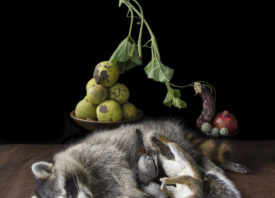
This stunning pastiche series of Dutch old master still life paintings was a collaborative effort by a Stockholm-based team; photographer Olivia Jeczmyk, stylist Joanna Laven and Fideli Sundqvist, a paper artist. Fideli can make pretty much make anything out of paper; a rock band doing a set, an exquisite meal, a bouquet of flowers. She also does lino-cuts and silhouettes too. Talented bunch, all at Agent Molly.

Olivia_Jeczmyk_Photography

Olivia_Jeczmyk_Photography

Olivia_Jeczmyk_Photography

This post was contributed by Sophie Chapman-Andrews, Head of Art Buying at McCann London

Deborah_Bay_Photography
.44 Magnum

I began thinking about The Big Bang after seeing a sales display of bullet-proof plexiglas with projectiles embedded in it. The plexiglas captured the fragmentation of the bullets and provided a visual record of the energy released on impact. In deciding to explore this concept further, I also was intrigued by the psychological tension created between the jewel-like beauty and the inherent destructiveness of the fragmented projectiles. Many of the images resemble exploding galaxies, and visions of intergalactic bling sublimate the horror of bullets meeting muscle and bone.—Deborah Bay

Houston-based photographer Deborah Bay gives us that interesting mix of creating a beautiful visual to comment on a darker issue. The Big Bang addresses the steadfast affection America has for its firearms. The topic is especially relevant for the native Texan, who lives in a state that has an estimated 51 million firearms. The images were made in Bay’s studio after law enforcement professionals from the Public Safety Institute of Houston Community College shot at sheets of plexiglass.

Deborah_Bay_Photography
Five-seveN I

Deborah_Bay_Photography
.22 Long Rifle

Deborah_Bay_Photography
.357 Jacketed Hollow Point

Deborah_Bay_Photography
.45 Hollow Point II

Deborah_Bay_Photography
9 mm Glock Ball

Deborah_Bay_Photography
9mm Uzi

Deborah_Bay_Photography
.357 Hollow Point

Deborah_Bay_Photography
9mm Automatic

Deborah_Bay_Photography
.44 Caliber

Mitch_Payne_Photography

Each image depicts a glass tank housing various setups acting as ‘energy sources’ which power a lightbulb. The series includes ‘Geothermal’ where coloured gravel is layered up to represent a cross section through earth and ‘Tidal’ where water is seen dramatically splashing like a giant wave within the glass tank.

London-based photographer Mitch Payne, Designer Kyle Bean and Art Director Gemma Fletcher have joined forces to create Renewable Energy, a playful still life project that visually represents different forms of renewable energy—energy that comes from resources which are continually replenished like solar, nuclear and wind. The smart, eye-catching images take us back to the classroom, and we’re happy to be schooled by these creatives any day.

Mitch_Payne_Photography

Mitch_Payne_Photography

Mitch_Payne_Photography

Mitch_Payne_Photography

jan Groover galerie paul frèchesJan Groover’s work is currently on display at Galerie Paul Frèches in Paris through May 18, 2013.

Nick_Albertson_photography

Boston-born photographer Nick Albertson recently talked to us about his abstract series of everyday objects Form Over Function. He is an MFA candidate in Photography at Columbia College Chicago and is expecting his first solo show at Aspect Ratio Projects in Chicago in early 2014.

Nick_Albertson_photography

Nick_Albertson_photography

Your images are very minimal and sometimes abstract and there seems to be a relationship or reference in your work to painting and drawing. Can you talk a little about that?
“I would first specify that while my photographs have a formal relation to some abstract painting, I consider photography in general to be very linked to an indexical relationship with the world and only abstract in the sense that all two-dimensional images are abstract representations of a three-dimensional world.

“My photographs often have the aesthetic and formal qualities of abstract painting, but they are representations of objects the same as any other photograph. I find the work of artists from movements such as abstract expressionism and minimalism to be extremely beautiful. However, I find the accompanying notion of the artist-as-visionary and the general self-seriousness of these artists to be off-putting and outdated.

“In my photographs I use everyday household materials as a way of poking fun at the seriousness of it all. The artist’s hand is supposed to translate their artistic genius, so what happens when the gesture has been created by a mass-produced object? Can we reconcile the mundaneness of the objects with high art aspirations inherent to the modernists?”

Nick_Albertson_photography

In some of your images it is really obvious what materials you are using, like envelopes, rubber bands, etc., and other times not at all. How important is it for the viewer to understand what they are looking at?
“It is not my goal to fool anyone, or to have a viewer wonder what he or she is looking at, only to figure it out and move on. I want to create an experience for the viewer. Sometimes the photograph can succeed experientially and still provide the viewer with identifiable objects. Other times I find that in order to create the emotion I am after I have to obscure the material. I see both strategies working together.

“My main concern is with the form of the material, depriving it of its functionality. The objects I photograph are designed to be utilitarian, and generally most people do not spend much time examining them. I provide images that decontextualize the objects, but offer the opportunity to contemplate them as pure form.”

Nick_Albertson_photography

Nick_Albertson_photography

How do you go about choosing your materials to photograph? Are there any materials that you are specifically avoiding?
“My criteria for choosing materials are loose, or at least hard for me to put into words. I look for materials that are generally found in most homes or offices. I seek out generic objects, visually and in terms of branding. Everything I use has to be sold in large quantities and be minimal in its design. Mass production and interchangeability, or a lack of individuality, are key points. I tend to shy away from objects that are not malleable or have logos for aesthetic reasons.”

Nick_Albertson_photography

Nick_Albertson_photography

Light and shadow seem to play a crucial role in your work. You seem to use it in a way that creates a sense of depth to the image. Can you talk about the role light plays in the work? Are you trying to create a sense of depth and layering to the image?
“One thing inherent to photography is that light is rendered as a material. It is frozen in time and given form, just as, say, a rubber band or any physical object is. The camera lens records reflected (and sometimes direct) light.

“I use light much in the same way I use the household materials to craft my images. It becomes tangible, something to manipulate in the service of the composition. Oftentimes, as you have mentioned, I use it to create depth. But other times I flatten the image largely through the lighting. Painting, similarly, can allude to depth or it can feel very flat.”

Nick_Albertson_photography

Nick_Albertson_photography

Who or what inspired you to start making these images?
“That’s a hard question to answer. It definitely came about organically. I had started using similar materials and a somewhat similar aesthetic for a different, earlier project, and it just morphed into what I am doing now.

“Intuition and play guides my process. I pick up a rubber band and play with it unconsciously. A few days later, when I find myself playing with it again, I make a subconscious note of it. The third time I recognize the rubber band as a unique and interesting material and decide to make a photograph of it.”

Nick_Albertson_photography

Nick_Albertson_photography

This post was contributed by photographer Clarissa Bonet.

Peter LippmannDigitale Pourpre

Paris-based photographer Peter Lippmann appeals to our eye with his personal work Medicinal Plants / Les Vertus des Plantes, a botanical array honoring the unique qualities of nature’s best. Beautiful and crisp, these images have healing powers of their own.

Peter LippmannAllium

Peter LippmannValeriane

Peter LippmannAngelique

Peter Lippmann Aconit

Peter LippmannJusquiame

Peter LippmannBleuet

Peter LippmannLaurier