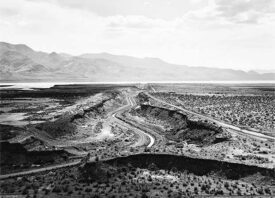
Alex MacLean is a pilot and photographer based in Massachusetts who has flown his plane over much of the United States documenting the landscape. Trained as an architect, MacLean has portrayed the history and evolution of the land from vast agricultural patterns to city grids, recording changes brought about by human intervention and natural processes. His powerful and descriptive images provide clues to understanding the relationship between natural and constructed environments.


This post was contributed by photographer Andi Vollmer.

Jakarta
Martin Roemers studied photography at the Academy of Arts in Enschede, the Netherlands. His work has been exhibited widely and is held in public, private and corporate collections including the Rijksmuseum in Amsterdam and the Ford Foundation in New York. He has received awards and recognitions including two World Press Photo Awards in 2006 and 2011. These photographs of megacities are from his series Metropolis, which is currently on view at Anastasia Photo in New York.
Calcutta
Bombay
Tell us about Metropolis and how it came about?
‘Half of humanity lives in a city, and the United Nations has predicted that 70 percent of the world’s population will reside in urban areas by 2050. Hence, I am photographing the world’s megacities; places with populations in excess of ten million. I wanted to explore how it is that people are able to live in cities that are so immense and crowded. The answer is that even with their bustle and chaos, megacities retain their human aspects. And this is what I want to reveal by taking photographs of crowded places where you notice not only the city’s dynamic character but also the urban traveller making his way through today’s modern society.
‘Specifically, I’m looking at the small stories of the street vendor, the commuter, the passer-by, the market stallholder and other pedestrians, who populate the street or are a part of the traffic. Despite the megacity and its mega-commotion, their environment still maintains a human dimension. I present this by photographing busy locations from above. Moreover, every photo has a long exposure time so that the city’s vitality is shown through the movement of people and traffic while the image literally focuses on the small story in question. Every megacity is a theatre and every city has a different stage and different actors. In the end every single one of them is trying to make his way in today’s urban society.

Calcutta
You have explored using long exposures in other projects, such as using an antique camera with a 10 second long exposure time to make portraits in Afghanistan. How do long exposures change the process of image making?
‘Especially for Metropolis the long exposure is necessary to show the dynamics and energy of a city. It makes me look differently at a street scene because some people can only be a usable element when they move/walk and other people/vehicles are only usable when they don’t move at all.’
Manila
Karachi
How did you choose your locations and vantage points?
‘During the day I drive and walk through the city looking for suitable crowded locations. I also have to have access to a high point like a balcony or a rooftop. At the end of the day (when the light is good), I usually have one or two usable locations to work with. Then, I’ll wait until all elements fall into place, which is something that I am never sure of. It is always a surprise when I have developed the film and see what is there.’
Bombay
Karachi
This post was contributed by photographer Greta Rybus.

Walker Pickering is an Austin based photographer. He received his MFA in photography from Savannah College of Art and Design, and currently teaches photography at the Art Institute of Austin. He has participated in a number of solo and group exhibitions, and has been a photographer for the Texas House of Representatives. These images are taken from his series ‘Nearly West’.
‘Nearly West’ continues the grand tradition of socially engaged photographic road trips across the United States. With his medium-format film camera, he discovers and documents an panoply of American places in square-format photographs that remind us of who we are as individuals and members of a society. Urban parking lots, rural roads, monuments, motel rooms, and roadside attractions receive Pickering’s equal, loving attention. Often infused with golden sunlight and blending beauty with apparent ugliness, his landscapes are both physical and psychic spaces.


This post was contributed by photographer Andi Vollmer.


Leon West is a South Wales photographer with a wistful heart and a passion for detail. Creating intricate landscapes with an 8×10 Deardorff field camera, he composes visceral images with an ephemeral beauty. A quality ever present in Southernmost, an exploration of the most Southerly point of Wales.


This post was contributed by photographer Teresa LoJacono.

Erin Fitzsimmons photographs urban and rural landscapes and also works commercially in architectural photography. Shanghai Nights was shot in 2011 and focuses on the demise of the old Shanghai. Fitzsimmons writes:
Shanghai is the epitome of the dichotomy which is China, an ancient place which is thrusting itself into the future while seemingly discarding the past with disregard. Old Shanghai is a shattered version of its former self, a town of wood and brick in a city of steel and concrete. This creates a place which seems to bring about its own death, but whispers of charm and beauty can still be heard at night in narrow streets and alleys.


Emma Hardy is a photographer based between London and Suffolk. Sparse landscapes with unexpectedly vast skies and dramatic light provide constant stimulation for her photographic eye and a backdrop for her fashion, editorial and portraits alike.
Describing her aesthetic as raw but tender, Hardy finds beauty in imperfection, and polish in the detail of everyday life. ‘My photography reflects genuine instant, it’s about recognition of and surrender to a moment, catching it and letting it go’, she says. Through her lens, the most ordinary of moments appear steeped in romance and intrigue, as if her subjects are characters in a movie playing in her head.


This post was contributed by photographer Andi Vollmer.

Kyle Johnson is a Seattle-based editorial and advertising photographer. His photos have been featured in VICE, DAZED & Confused, Wallpaper* and Popular Mechanics among others. Of this project he writes:
‘The Last Frontier was my first look into our country’s most rugged and detached state; Alaska. During the trip via boat through Southeast Alaska, these moments were my observations of the incredible landscapes as well as how they pair with the intimate communities and people who inhabit Alaska’.


Sheriff’s Cabin
Kyle Ford is an internationally published and exhibited artist based out of upstate New York. He splits his time between photographing at Adirondack Park and teaching at Skidmore College in Saratoga Springs. Of his most recent series, Forever Wild, Ford writes:
‘In the 1890’s a boundary of 6.1 million acres in northern New York, known as the “blue line,” was placed under constitutional protection forming the largest park in the continental US. Since then, public land in this place has been governmentally sanctioned as “forever wild.” Currently in progress, these images are a series about the land and inhabitants of the park’.
The Hunter
Boat Launch at First Snow
St. Gabriel’s
Roadside Swamp with Beaver Lodge
Nicholas, On Bigelow Road
The Flood
Frontier Town


Hengki Koentjoro was born in Semarang, Central Java, Indonesia, in 1963. He is a graduate of the Brooks Institute of Photography in Santa Barbara, California where he majored in film. He now lives in Jakarta where he specializes in fine art photography both underwater and on land.
Photography is not just a way of expressing his most inner soul but also creating a window to the world where through his pictures the unseen and the unspoken can be grasped. Driven by the desire to explore the mystical beauty of nature, he develops his sense and sensibility through the elements of fine art photography. His freedom of expression is more reflected in the elaboration and exploration of black and white.
Photography can never be separated from the aspects of making the common things unusual, welcoming the unexpected, indulging and embracing ourselves with the joy of photography as well as believing that anything is possible.