Posts tagged as:

food photography

beth_galton_Photography

This series was inspired by an assignment in which we were asked to cut a burrito in half for a client. Normally for a job, we photograph the surface of food, occasionally taking a bite or a piece out, but rarely the cross section of a finished dish. By cutting these items in half we move past the simple appetite appeal we normally try to achieve and explore the interior worlds of these products.
Beth Galton

Cut Food, a series by New York-based still life and food photographer Beth Galton, delivers an eye-pleasing, intriguing new look at what we eat. A collaboration with food stylist Charlotte Omnès, the duo worked meticulously to showcase the dynamic cross sections, each one differing in level of difficulty to achieve. Some items looked great being cut in half without any manipulation—the donuts and ice cream, for example—while others proved to require some of Omnès’ handy styling tricks—like using gelatin to solidify liquid in the soup cans.

beth_galton_Photography

beth_galton_Photography

beth_galton_Photography

beth_galton_Photography

Zeiss

richard_haughton_Photography
Frédéric Anton, Le Pré Catalan. Sea Urchin, Gelée of Sea Urchin, Celery and Caviar

London-based food photographer Richard Haughton creates dazzling works of art with a clean, bright and inspired style. We asked Haughton to tell us about his many projects working with some of the best chefs in the world.

richard_haughton_Photography
Hachiro Miztani. Shima-aji

richard_haughton_Photography
Noriyuki Hamada, Yukawatan. Black Pudding of Carp Liver, Mousse of Carp and Apple, Port Sauce

You have a number of interesting projects on your website—Astrance, Poissons – Un Art du Japon and Yukawatan Noriyuki Hamada. Were these images shot for a cookbook or are they from a personal project?
“Nearly all the images on my site are from books that I’ve done. I’ve produced eight books with Michelin 3 star chefs, and others, like my book on Eric Briffard at the George V, with 2 or 1 star chefs. Each project tends to be quite different, as each chef has a very different personality, milieu, kitchen, and approach to food. What I am trying to do is express their personality and ideas, but I also want to focus as clearly as possible on the food and product itself, so that the viewer can understand what’s special about it, can almost touch it, and most importantly, wants to eat it! My pictures are about food, not lifestyle.”

richard_haughton_Photography
Frédéric Anton, Le Pré Catalan. La Framboise, Creme Glacée

richard_haughton_Photography
Petits Gateaux, Frédéric Anton. Cherry fruit jelly.

My favorites are your Frédéric AntonPetits Gateaux images. What was the idea behind these?
“Frédéric Anton is a fun chef to work with, as he’s very creative visually, and can come up with many ways of re-presenting the same dish. He’s very graphic and conceptual. The first book we did together, Anton, which won the Gourmand Best Chefs Book in the World in 2009, is a “chef” book. Petits Gateaux is the first in a series we’re doing which is more of a general public book. The second, Pommes de Terre is out, though not on my site yet, and we’ve just finished shooting the third, Tartes.”

richard_haughton_Photography
Petits Gateaux, Frédéric Anton. Rasberry jam cooking.

richard_haughton_Photography
Pascal Barbot, L’Astrance. Blood Orange.

The way the food is lit in your images is fantastic. What kind of lighting effects do you use?
“Nearly everything I do is lit with flash, or sometimes flash and daylight, though very rarely just with daylight—it’s too variable, and often there’s not much choice of location, as everything has to be done as close as possible to the kitchen. Astrance for example, with the great genius Pascal Barbot, was entirely shot on top of the rubbish bins in the tiny courtyard outside the kitchen!

“I try and create a different light for each project, and that’s affected by the chefs style and by the physical properties of whatever space I have to work in. Nothing is done in a studio, I have to make one wherever I am, which means that I spend a lot of time traveling with about 65 kilos to carry. I work with Canon cameras, and actually do a lot of my close up work with a tiny G10.”

richard_haughton_Photography
Pascal Barbot, L’Astrance. Asparagus, Citrus, Almond.

richard_haughton_Photography
Pascal Barbot, L’Astrance. Sprout leaf, detail of Hare, Quince and Shallots.

Do you work with a stylist to create the images?
“I don’t, it’s not necessary with these kinds of chefs. I work directly with the chef, deciding the best visual point of view for a particular dish, the best kind of plate, the best presentation.”

richard_haughton_Photography
Eric Briffard, Le Cinq. Root Vegetables with Truffle Vinaigrette.

richard_haughton_Photography
Noriyuki Hamada, Yukawatan. Detail, Spherification of Apple.

Do you add any treatment to the images in post-production?
“There is usually quite a lot of post production work, but it’s nearly always doing things that would take too much time to do when shooting—as time is always pretty limited—so mainly things like cleaning up backgrounds. If I have to shoot in a bright yellow room for example, there will always be a color cast to correct.

“The food itself I don’t mess with. These are some of the greatest chefs in the world, I don’t need to tamper with their work. Occasionally I will do a bit of tidying of a cut, or tweak the positioning or proportion of things on the plate to adjust for the camera’s point of view. I’m working with absolute perfectionists, and I have to be one myself. The book I’ve done with Jean-Georges Klein presenting dishes in a background that suggests one of the four elements has the most obviously “manipulated” images, but in fact they have almost no Photoshop work, and are all done using good old fashioned photographic techniques.”

richard_haughton_Photography
Jean-Georges Klein, L’Arnsbourg. Salad of Seaweed and Shellfish.

This post was contributed by photographer Helen Grace Ventura Thompson.

Yuichi_Nishihata_Photography

Since majoring in food science at the University of Tokyo in 2009, Yuichi Nishihata developed a strong interest in food. While working as a chef after university, Nishihata noticed how much food was being thrown away at the end of his shift and thought deeply about food consumption and how he could show this as a visual statement. His images from the series entitled ‘Food as Object’ are based on this – the juxtaposition between natural food stuffs and what Nishihata calls the “super quick mass consumption age”. All his work is based on the coexistence and relationship between nature and human beings.

Through this series ‘Food as Object’, Nishihata photographed fruit and vegetables to make them look almost like creatures. Using low-key lighting, the food objects look like strange organisms, partially hidden in darkness. Nishihata intends for the viewer to consider food as not just food, but as living organisms. He feels this can easily be forgotten in our world of fast food, microwave meals and mass consumption.

Nishihata currently shoots out of his studio in Berlin, working on his on-going project ‘Destruction of Digital images and creation’ looking at how the digital image is a collective body of colour and not a handheld object that can be left behind.

Yuichi_Nishihata_Photography

Yuichi_Nishihata_Photography

Yuichi_Nishihata_Photography

Yuichi_Nishihata_Photography

Yuichi_Nishihata_Photography

Yuichi_Nishihata_Photography

This post was contributed by photographer Helen Grace Ventura Thompson.

Pink SquirrelPink Squirrel

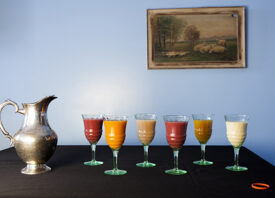
This series was inspired by my love for the TV series Mad Men. An amateur mixologist and cocktail enthusiast myself, I began researching vintage cocktails and collecting classic glassware on my flea market adventures to create these portraits of vintage cocktails. This is an ongoing series that I continue as my glassware collection continues to grow.—Sarah Ann Ward

Sarah Ann Ward is a New York-based photographer specializing in food/drinks, soft-goods and product photography.

Blue LagoonBlue Lagoon

Mint JulepMint Julep

Whiskey SourWhiskey Sour

CosmopolitanCosmopolitan

Bloody MaryBloody Mary

egg nogEgg Nog

food-collage Julie Lee

Los Angeles based food blogger Julie Lee likes to document her culinary adventures and farmers market travels with her iPhone. Unexpected concoctions from ginger-molasses ketchup to guava smoked sea salt can be found in her graphic Instagram collages. The shots, which would make amazing wallpaper, also come with little tips related to creative cooking.

food-collage Julie Lee

food-collage Julie Lee

food-collage Julie Lee

food-collage Julie Lee

food-collage Julie Lee

food-collage Julie Lee

via The Fox is Black

International Street Photography Awards

Nadege Meriau

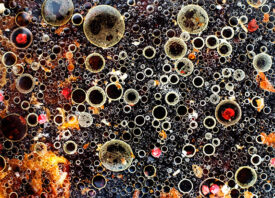
UK based photographer Nadege Meriau transforms food and natural matter into visceral, primeval dwellings and grottos reminiscent of the underworld. Her meticulous and creative eye takes these fruits and vegetables to the next level. Olivier Richon, Head of Photography at the Royal College of Art in London where Meriau recevied an MA in Photography, describes this series perfectly:

If in fairy tales, houses are made of sweets, Nadege Meriau does the reverse, transforming the edible into a dwelling, making architectures of fibers, vegetables and porous matter. This is an architecture of the digestible, made of curves and unexpected textures, that recall the art of the rocaille, or when a grotto is endowed with a viscosity that reminds us of a digestive apparatus.—Olivier Richon

Nadege Meriau

Nadege Meriau

Nadege Meriau

Nadege Meriau

Nadege Meriau

Nadege Meriau

Nadege Meriau

via It’s Nice That

If you’re a photographer, you can now promote your new series, website, gallery show, recent assignment, etc. on Feature Shoot for an affordable price. Find out about becoming a Spotlight Photographer here.

Barbara Ciurej & Lindsay Lochman Photo: Barbara Ciurej & Lindsay Lochman

Henry-Hargreaves Rothko rice

Inspired by the recent defacing of the Rothko work ‘Maroon on Black’ at the Tate Modern in London, photographer Henry Hargreaves and chef/stylist Caitlin Levin set out to reinterpret Rothko’s famous works using colored rice and photography as their medium.

After hearing about this event I read deeper into the back story of this work and I found this series to have a really intriguing history and link to food. Rothko was commissioned to paint an installation for the new Four Seasons restaurant in New York. It was 1958 and the Four Seasons was to be the pinnacle of fine dining in New York. It was a bizarre commission for him to accept as he despised the excess, pretense and crowd the restaurant was hoping to attract. Rothko claimed that he tried to create “something that will ruin the appetite of every son-of-a-bitch who ever eats in that room. If the restaurant would refuse to put up my murals, that would be the ultimate compliment. But they won’t. People can stand anything these days.”

After completing 40 works he went back on the offer returned the money and the series is now split between the Tate in London, the National Gallery of Art in Washington, DC and the Kawamura Memorial Museum in Japan.

The three darker works (pictured here) are inspired by this infamous Segram mural series. And we have to agree with Rothko, they don’t really stimulate the appetite.—Henry Hargreaves

Henry-Hargreaves Rothko rice

Henry-Hargreaves Rothko rice

Henry-Hargreaves Rothko rice

Henry-Hargreaves Rothko rice

Henry-Hargreaves Rothko rice

Henry-Hargreaves Rothko rice

Slideluck-DC

Food on Mars

by Alison Zavos on October 10, 2012 · 0 comments

Ilyse-Krivel food from mars

The series Food On Mars shows that mysterious forces from out of this world can be found in everyday objects such as food. The viewer perceives extravagantly arranged food images but on closer look everything is not as it seems and details of demonic faces make themselves seen.

The series pokes fun at the attention and detail we give to material things and strives to point at the magical and transient forces that lie beneath everything. Like a Rorschach test, each person may see something new lurking in the shadows.—Ilyse Krivel

Ilyse Krivel is a photographer based in Toronto.

Ilyse-Krivel food from mars

Ilyse-Krivel food from mars

Ilyse-Krivel food from mars

Ilyse-Krivel food from mars

Ilyse-Krivel food from mars

Slideluck-DC

Tsuyoshi Ozawa vegetable guns

Since 2001, Japanese photographer Tsuyoshi Ozawa has been traveling around the world photographing young women holding guns fashioned mainly from vegetables. As part of the process, the ingredients are chosen by Ozawa’s models and make up a hot-pot dish native to their country. After the portrait is completed, the “gun” is disassembled and Ozawa and his model share a meal made up of its parts.

Vegetable Weapon, a collaborative project promoting peace, will be on display at Misa Shin Gallery in Tokyo from September 21-November 2, 2012.

Tsuyoshi Ozawa vegetable guns

Tsuyoshi-Ozawa vegetable guns

Tsuyoshi Ozawa vegetable guns

Tsuyoshi-Ozawa vegetable guns

via Spoon & Tamago

If you’re a photographer, you can now promote your new series, website, gallery show, recent assignment, etc. on Feature Shoot for an affordable price. Find out about becoming a Spotlight Photographer here.