Posts tagged as:

still life photography

David_Goldes_Photography

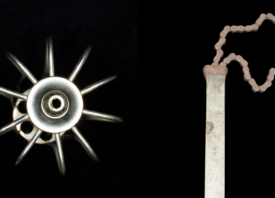
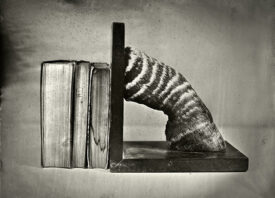
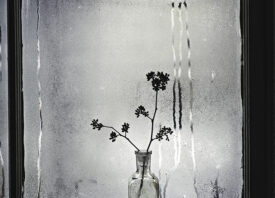
I discovered Minneapolis-based photographer David Goldes’ black-and-white series, Traces a few years back, and was immediately enchanted by the strange beauty of the project. Asking what inspired him to create the unique still lifes: “I asked myself if an object could be something both physical and a memory at the same time. The French philosopher Sartre said that imaginary objects (in contrast to actual perceived objects) have a sort of translucency. This enables us to imagine all sides of the objects at once. In my pictures, the partially transparent mesh objects are linked to the idea of memory. The metallic mesh has the literal shape of the object that it was once wrapped around.”

Explaining how he came to using mesh, “I was trying to re-make photographically a mid-19th century experiment by British scientist C.V. Boys. While investigating the surface tension of water, he carefully filled a bowl made of mesh with water so that it did not leak. The experiment was interesting and it was a success. The surprise was the beauty of the metallic mesh bowl.”

David_Goldes_Photography

David_Goldes_Photography

David_Goldes_Photography

David_Goldes_Photography

David_Goldes_Photography

David_Goldes_Photography

Feature Shoot Contributing Editor Carolyn Rauch is the Deputy Director of Photography at Newsweek.

lonnekevanderpalen_Photography

We recently talked to Netherlands-based photographer Lonneke Van Der Palen about her unique style and approach to photography.

lonnekevanderpalen_Photography

What project best represents your photography?
“I’d say that my series Souvenir: memories of a journey never made is the best example. This project was informed by a very personal point of view, and while working on it I didn’t have to conform to anyone else’s opinions. The iconic approach, to both people and objects within the series often poses as an example for me when I work on new projects. You could say that all my work can be linked in one way or another, to Souvenir.”

lonnekevanderpalen_Photography

lonnekevanderpalen_Photography

Your style is really cohesive, how do you manage to keep a personal and recognizable vision also in commissioned works?
“I think that the creative process of an artist is connected to personal tastes and a personal vision. I feel this should always be reflected in one’s work. That way, no matter how different one commissioned series is from another, you will always be able to recognize a certain personal edge to everything one makes.

“In my case this is strongly dependent on certain choices I make. I feel like I have found a way to approach objects that is very much my own. I also have a very particular way of working with colors and light within my projects. That personal edge is what clients are looking for when they enlist me.”

lonnekevanderpalen_Photography

I like that Souvenir feels like I’m looking at a place that isn’t anywhere. Tell me more about the project.
“The series is the result of a staged journey inspired by the ultimate clichés among travel photography. The posing in stunning landscapes, sunsets, wildlife, exotic food, the indigenous population: they almost become icons.

“By recreating these images, photography enables me to visit distant worlds and gather souvenirs of a journey that has never been made. Why buy expensive flight tickets, when I can accomplish the same with my imagination? Using a camera, I don’t have to leave my house to experiences life’s visual marvels.”

lonnekevanderpalen_Photography

lonnekevanderpalen_Photography

This post was contributed by photographer Martina Giammaria.

winona

When I saw Winona Barton-Ballentine’s Home Studies prominently displayed in the ICP-Bard MFA group show, currently on view at ICP’s midtown educational center, I immediately felt drawn to their obvious sincerity and consideration. In a climate where combining random objects for no particular reason on a brightly colored background seems de rigueur, Barton-Ballentine’s domestic still-life photographs offer a warmly personal alternative. I recently asked her a couple of questions about the series.

The ICP-Bard MFA group show is on view through May 9th, 2013. Barton-Ballentine’s work can also be viewed in the group show Secession Secession, curated by Colby Bird at Fitzroy Gallery in NYC.

Winona_Barton-Ballentine_Photography

How did you begin working on Home Studies?
“I was living in Arles, France for two months while doing a residency/exchange, and stayed at home making still-lifes all day, listening to music, looking at maps, and experimenting with French recipes. That’s when food, fabric, and domestic items came into the pictures.

“I was thinking about objects that I choose to surround myself with in America versus what I was attracted to in France where I bought things to satisfy that anxiety of being away; to try to create a sense of home. This often included things from the market and/or things that reminded me of my Lebanese and French Canadian grandmothers—both amazing cooks.

“Back in Brooklyn, part of my system for making these images was to only use objects that already existed in my home as a way to challenge the desire to consume, and to ween myself away from the mindset that to buy something meant that I would make a better photo. Instead I wanted to make the things in the images.

“This felt important to me after years of working in fashion photography. I’m also considering the tradition of domestic craft, which both intrigues and terrifies me. I knit, cooked, chopped, sewed, strung, and constructed the images in a way that embraced the imperfection of the hand-made versus mass-produced. I often found this part to be slow and frustrating compared to the immediacy of photography. It was, however, satisfying in a physical, primary way.”

Winona_Barton-Ballentine_Photography

What do these photos mean to you?
“They represent this time in my life and in history, as a woman, a wife, an American, and an artist. With the abundance of new technologies, image-making styles, and production resources, I chose to re-visit the foundational tools of photography—framing, timing, and focus. This seemed a fitting framework for examining the history of domestic [still] life.

“I’m interested in the place where personal questions reflect the feelings of other people in my generation and cultural circumstance. There’s no better space for this than the home. Three questions arise: how does treatment of domestic space reflect circumstance? And beyond that: what conscious or unconscious decisions determine how I create my space, and why?”

Winona_Barton-Ballentine_Photography

Feature Shoot Contributing Editor Matthew Leifheit is an independent writer, curator, and photographer based in New York City.

beth_galton_Photography

This series was inspired by an assignment in which we were asked to cut a burrito in half for a client. Normally for a job, we photograph the surface of food, occasionally taking a bite or a piece out, but rarely the cross section of a finished dish. By cutting these items in half we move past the simple appetite appeal we normally try to achieve and explore the interior worlds of these products.
Beth Galton

Cut Food, a series by New York-based still life and food photographer Beth Galton, delivers an eye-pleasing, intriguing new look at what we eat. A collaboration with food stylist Charlotte Omnès, the duo worked meticulously to showcase the dynamic cross sections, each one differing in level of difficulty to achieve. Some items looked great being cut in half without any manipulation—the donuts and ice cream, for example—while others proved to require some of Omnès’ handy styling tricks—like using gelatin to solidify liquid in the soup cans.

beth_galton_Photography

beth_galton_Photography

beth_galton_Photography

beth_galton_Photography

Zeiss

Henry-Hargreaves_Photography

Lady Gaga – small plate of cheese (non-smelly, non-sweaty) on ice.

I was inspired to create this series after reviewing a few riders from some of the biggest acts in the world, all of which were ridiculous. But what I found most interesting about them is that they offered a glimpse into their larger-than-life personalities.

I decided to focus on the quirkiest requests and shoot them in a Flemish Baroque still-life style because I felt that there was a direct connection between the themes in these types of paintings and the riders: the idea of time passing and the ultimate mortality of a musician’s career as the limelight inevitably fades.—Henry Hargreaves

Here’s another fun project from Brooklyn-based photographer Henry Hargreaves. This time he brings to life the items requested in riders from a handful of famous musicians, Dutch-still life style.

Henry-Hargreaves_Photography

Rihanna – Hard boiled eggs, turkey bacon, turkey sausage at any time throughout the day, please be prepared!

Henry-Hargreaves_Photography

Mariah Carey – Cristal Champagne, bendy straws.

Henry-Hargreaves_Photography

Frank Sinatra – 1 bottle each: Absolute, Jack Daniels, Chivas Regal, Courvoisier, Beefeater gin, white wine, red wine, 24 chilled jumbo shrimp, life savers, cough drops.

Henry-Hargreaves_Photography

Van Halen – Herring in sour cream, large tube of KY jelly, M&M’s (warning absolutely no brown ones)

Henry-Hargreaves_Photography

Nine Inch Nails – 2 boxes of corn starch

Henry-Hargreaves_Photography

Al Green – 24 long stem (dethroned) red roses

Henry-Hargreaves_Photography

Axl Rose – Fresh Wonder Bread (white), Dom Perignon

Henry-Hargreaves_Photography

Juicy baked chicken. Garlic, sea salt, black pepper and Cayenne pepper HEAVILY SEASONED!! Beyonce can only have Pepsi products.

Henry-Hargreaves_Photography

Britney Spears – Fish and chips, McDonalds cheeseburgers without the buns, 100 prunes and figs, a framed photo of Princess Diana.

Henry-Hargreaves_Photography

Busta Rhymes – 24 piece Fried Chicken, Rough Rider condoms, Guinness.

Henry-Hargreaves_Photography

Foo Fighters – Big ass kielbasas that make men feel self conscious.

Henry-Hargreaves_Photography

Marilyn Manson – Gummi bears.

Henry-Hargreaves_Photography

New Kids on the Block – Haagen Das ice cream, Oreo cookies.

Henry-Hargreaves_Photography

Prince – coffee and tea set up (include honey, lemon, sugar, cream, fresh ginger root), physician will be used to administer a B-12 injection.

Henry-Hargreaves_Photography

Billy idol – 1 tub ‘I can’t believe it’s not butter,’ Pepperidge farms Soft Baked Nantucket chocolate chip cookies.

William_Mebane_Photography

Legendary photographer Harry Callahan’s routine was to go out and make new photographs every day, whether or not there was anything in particular he wanted to shoot. Adopting this method, Brooklyn-based photographer William Mebane uses his new blog Villeburg as a tool in his photographic process.

A repository for great images that don’t exactly fit into a series, the photos on Villeburg are nonetheless very carefully edited and sequenced—Mebane describes it as “a place where I can share my process with friends and work on editing and pairing photographs that might fit into future projects. It’s an outlet for work that I’ve been making on a daily basis.”

William_Mebane_Photography

William_Mebane_Photography

William_Mebane_Photography

William_Mebane_Photography

William_Mebane_Photography

William_Mebane_Photography

William_Mebane_Photography

William_Mebane_Photography


Feature Shoot Contributing Editor Matthew Leifheit is an independent writer, curator, and photographer based in New York City.

Thomas_Albdorf_Photography

In his new series Former Writer, Part 1: Colour on Surface, Vienna-based photographer Thomas Albdorf builds on his past as a graffiti writer. By making blunt spraypaint interventions both in the real world and in his studio, he bends space and creates fluorescent visual play. In the vein of John Divola’s Zuma series, Albdorf physically marks his subject as evidence of his involvement. Part two of the series, already in progress, will combine sculptures, drawings and prints, while bringing them into real space. Here is a punk rock approach to the contemporary photographic still life.

Thomas_Albdorf_Photography

Thomas_Albdorf_Photography

Thomas_Albdorf_Photography

Thomas_Albdorf_Photography

Thomas_Albdorf_Photography

Thomas_Albdorf_Photography

Thomas_Albdorf_Photography


Feature Shoot Contributing Editor Matthew Leifheit is an independent writer, curator, and photographer based in New York City.

Reiner_Riedler_Photography
Trois Couleurs; Bleu by Krzysztof Kieslowski, 1993

Austrian photographer Reiner Riedler’s new project, the appropriately titled The Unseen Seen is a series of macro shots of original filmrolls. Having gained access to The Deutsche Kinemathek, Berlin museum and film archive—home to 13,000 national and international film titles—Riedler selected a mix of well-known cult classics and lesser known films to photograph. He set up a makeshift studio in the archive, using film lights to backlight the filmrolls, lighting each one in the same way for continuity. Alone the images present an interesting graphic visual, but Riedler hopes that coupled with the film titles they will rouse the viewer’s unique associations with the film.

Riedler is represented by AnzenbergerAgency and his fine art prints can be bought at AnzenbergerGallery.

Reiner_Riedler_Photography
Ginger E Fred by Federico Fellini, 1985

Reiner_Riedler_Photography
Der Blaue Engel (The Blue Angel) by Josef von Sternberg, 1930

Reiner_Riedler_Photography
The Godfather by Francis Ford Coppola, 1972

Reiner_Riedler_Photography
The Ghost Of Frankenstein by Erle C. Kenton, 1942

Reiner_Riedler_Photography
Bram Stoker’s Dracula by Francis Ford Coppola, 1992

Reiner_Riedler_Photography
Marlene Dietrich, a conversation with Dr. J. Robert Oppenheimer, Original Print

Reiner_Riedler_Photography
Ghosts by Christian Petzold, 2005

Reiner_Riedler_Photography
Scarface by Howard Hawks, 1932

Reiner_Riedler_Photography
Citizen Kane by Orson Welles, 1941

Adam_Voorhes_Photography

Brain Study no. 500, Teaching Brain Cross Sections on Gauze

I walked into a storage closet filled with approximately one-hundred human brains, none of them normal, taken from patients at the Texas State Mental Hospital. The brains sat in large jars of fluid, each labeled with a date of death or autopsy, a brief description in Latin, and a case number. These case numbers corresponded to microfilm held by the State Hospital detailing medical histories. But somehow, regardless of how amazing and fascinating this collection was, it had been largely untouched, and unstudied for nearly three decades.

Driving back to my studio with a brain snugly belted into the passenger seat, I quickly became obsessed with the idea of photographing the collection, preserving the already decaying brains, and corresponding the images to their medical histories.—Adam Voorhes

Two years ago Scientific American magazine sent Austin-based photographer Adam Voorhes to the University of Texas to borrow a human brain to photograph. That’s when he stumbled upon a cerebral mecca, a moment Voorhes describes above. Working with features journalist Alex Hannaford, the two have spent the last year investigating these fascinating specimens.

The collection dates back to the 1950s but the intent to study and display it was halted due to a lack of funding, and unfortunately the microfilm histories Voorhes mentions above were destroyed long ago. Luckily, the University of Texas has shown some new interest and is planning to make MRI scans of the brains, which will help piece together the collection’s history. Voorhes’ project seems particularly relevant as President Obama just announced a $100 million brain research initiative to develop new methods and technologies for understanding the human brain.

Adam_Voorhes_Photography

Brain Study no. 9, Down's Syndrome, 1983

Adam_Voorhes_Photography

Brain Study no. 331, Severe Developmental Anomaly of the Brain, 1978

adam_voorhes_Photography

Brain Study no. 318, Agyira Lobi. Fron. Lat. Utr., 1970

adam_voorhes_Photography

Brain Study no. 255, Hydrocephalus Internus et Exturnus, 1975

Adam_Voorhes_Phototgraphy

Brain Study no. 406, Teaching Brain Cross Section Dyed

Alla_Mirovskaya_photography

I want to sense the warmth of her heart anew, like in my childhood; to look closer and get to know my present, mature mother. To fixate, to remember, to feel acutely the moments of the life that I treasure, which is primordially a source of my own. Wise and not so wise, powerful and weak, young and mature, good and bad—anything she may be. My mom. Distant no more. Close…again.
Alla Mirovskaya

Driven by an inner motivation to comprehend her family reality, Russian photographer Alla Mirovskaya explores the complex relationship between mother and daughter in Distant and Close, a series that reads just like it sounds. She weaves together an intimate narrative through nostalgic, light-soaked images that explore identity, personality and kinship. Mirovskaya spent a year working on the project, navigating the waters of the familial great divide and connection—a documentary process she says prompted a rediscovery of her own worldview.

Alla_Mirovskaya_photography

Alla_Mirovskaya_photography

Alla_Mirovskaya_photography

Alla_Mirovskaya_photography

Alla_Mirovskaya_Photography

Alla_Mirovskaya_Photography

Alla_Mirovskaya_Photography

Alla_Mirovskaya_Photography

Alla_Mirovskaya_Photography

Alla_Mirovskaya_Photography