Posts by author:

Amanda Gorence

Sean_Miller_Photography
Microscopy of Dust Sample Collected from the Musee Du Louvre, Paris, France.

It was on the third floor of the Seattle Art Museum (SAM) in 1996 when Florida-based artist Sean Miller discovered a new subject for his work—dust. Working as an exhibition technician, one of his duties was to remove dust from the art displays: “performing this tedious, solitary, and meditative task in such an aesthetically charged environment made me consider this material in a special way. One day when I noticed a minute fiber had fallen from an African mask, I realized the art had dropped into, and joined, the dust.”

That’s when The Art Museum Dust Collection was born, an ingenious project that has had a myriad of incarnations over the years—to date the project includes dust from over 90 museums worldwide. Originally, it was started in collaboration with Miller’s SAM co-worker Phil Stoiber; they created a mail art project enlisting the help of museum employees around the U.S. to contribute dust samples and dusty white gloves to the collection.

In 2002, Miller began to photograph the dust specimens using microscopy. We can imagine the wide-eyed excitement he must have felt with that first image; “art museum dust is amazing because it is a hybrid of decaying art, the art institution, the art audience, artists themselves, and art administrators. Due to this synthesis it may be the most pure and significant material present in many museums.” Perhaps that’s why Miller’s specimens are so beautiful; they hold so much. They are also a testament to what makes a great artist—the discovery and display of something we would never have thought of.

In addition to the photographs, the project involves dust collecting performances, lectures, dust collecting equipment, wearable art, multiples, dust sculptures, and collages.

“Dust Sample from the Louvre” will be exhibitied in the upcoming exhibition, Ten Artists to Watch, from June 13–July 6, 2013 at the Los Angeles Center for Digital Art.

Sean_Miller_Photography
Microscopy of Dust Sample Collected from the Museum of Contemporary Art, Sydney, Australia.

Sean_Miller_Photography
Microscopy of Dust Sample Collected from the Museum of Modern Art, New York, NY., United States.

Sean_Miller_Photography
Microscopy of Dust Sample Collected from the Altes Museum, Berlin, Germany.

Sean_Miller_Photography
Microscopy of Dust Sample Collected from the Barcelona Contemporary Art Museum, Barcelona, Spain.

Sean_Miller_Photography
Microscopy of Dust Sample Collected from the Nelimarkka Museum, Alajärvi, Finland.

Sean_Miller_Photography
Microscopy of Dust Sample Collected from the Galleria Nazionale di Palazzo Spinola – Genoa, Italy.

Sean_Miller_Photography
Microscopy of Dust Sample Collected from the Tate Modern, London, England.

Sean_Miller_Photography
Microscopy of Dust Sample Collected from the Moderna Museet, Stockholm, Sweden.

Sean_Miller_Photography
Microscopy of Dust Sample Collected from the the Frick Collection, New York, NY., United States.

Zeiss

ai-photographic

Photographers and designers, we’ve teamed up with A&I Photographic to bring you the Photo Book Design Contest—it’s free to enter and the deadline is fast approaching.

Participants are asked to create a photo book using A&I’s Book Creator Software. Be sure to enter the code featureshoot2013 when completing the book order. If designers would like to purchase their submitted books, they will be offered at 20% off—just email the order number and request to marketing@aandi.com.

The best book design will be awarded a feature article on A&I’s blog, a post on Feature Shoot, and one printed copy of the winning book. The book will also be displayed at the 2013 HOW Design Live Conference in A&I’s vendor booth. Five Honorable Mentions will be awarded, and mentioned in the winner’s feature article on the A&I blog and on Feature Shoot.

Judges include Everard William and Richard Keys of Art Center College of Design, Alison and Zolton Zavos of Feature Shoot, Elizabeth Barr and Vic Lepejian of A&I Photographic, and Masha Kupets of Plastic Palmtree Inc.

Deadline for submissions is June 14, 2013.

A&I Photographic is a Feature Shoot sponsor.

GOOD Works Show

by Amanda Gorence on May 22, 2013

Dustin-CohenPhoto: Dustin Cohen

Organized by MergeLeft Artist Agents, GOOD Works is a group exhibition of photographers and artists who have donated their works to benefit ReesSpecht Life, a foundation created after Rich and Samantha Specht lost their 22 month-old son in a tragic accident. Inspired to continue his legacy of kindness, the proceeds will go to The Richard Edwin Ehmer Specht (Rees) Memorial Scholarship Fund to be reinvested in the community of Smithtown, NY. The primary goal of the fund and awareness campaign is to remind people the importance of community, compassion and civility.

The exhibition and silent auction features work from MergeLeft photographers, along with several talented artists: Mark Tucker, Dustin Cohen, Matt Furman, Gustavo Marx, Mike Rubendall, JK5, Margaret Malandruccolo, Christine Blackburne, Eli Neurgeboren, Jess Koehler, Beau Chamberlain, Alison Donalty, Jess Koehler, Erika Munro, Butch Anthony, Jessica Musumeci and David Curcurito.

It opens on Thursday, May 23rd at 6:30pm at Fig. 19 Gallery in the Lower East Side, Manhattan.

Mark-TuckerPhoto: Mark Tucker

Matt-FurmanPhoto: Matt Furman

Doug_Ischar_Photography

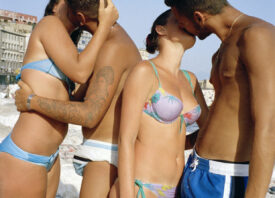
Marginal Waters, shot by American photographer Doug Ischar in 1985, documents one of the most visible urban gay beaches in North America—on the Belmont Rocks in the city of Chicago—during the height of the AIDS crisis. The images are multi-layered, they “depict a seemingly edenic world of toned, sun-bathed bodies, behind which lurk the spectres of AIDS and reaction.”

Undertow, a three part exhibition featuring Ischar’s Marginal Waters, his installation work of the 1990s, and his recent experimental films, is currently on view at Gallery 44 in Toronto, as part of the Scotiabank CONTACT Photography Festival. It runs through June 15, 2013.

Doug_Ischar_Photography

Doug_Ischar_Photography

Doug_Ischar_Photography

Doug_Ischar_Photography

Doug_Ischar_Photography

Doug_Ischar_Photography

Doug_Ischar_Photography

Doug_Ischar_Photography

Doug_Ischar_Photography

Doug_Ischar_Photography

Doug_Ischar_Photography

Doug_Ischar_Photography

Doug_Ischar_Photography

Doug_Ischar_Photography

Doug_Ischar_Photography

Brian_Finke_Photography

New York-based photographer Brian Finke has a new long-term project in the works entitled Hip Hop Honeys, a document of the models and culture in hip hop videos. Working with casting directors to obtain access, Finke says he is just getting started with the project, seeing what direction it takes—we think it’s safe to say, so far, so good.

Brian_Finke_Photography

Brian_Finke_Photography

Brian_Finke_Photography

Brian_Finke_Photography

Brian_Finke_Photography

Brian_Finke_Photography

Brian_Finke_Photography

Brian_Finke_Photography

Brian_Finke_Photography

Ryann_Ford_Photography
Near Big Bend National Park, Texas

All over the country, rest areas are losing the fight to commercial alternatives: drive-thrus at every exit and mega-sized travel centers offering car washes, wi-fi, grilled paninis and bladder-busting sized fountain drinks. Louisiana has closed 24 of its 34 stops, Virginia, 18 of its 42; pretty much every state in the country has reduced its number of rest areas, or at least cut operating hours. And they’re not just being closed, they’re being demolished.

For the past 53 years, rest stops have given us rest, relief, hospitality and nostalgia. They have been an oasis of green to walk your dog, have a picnic, study the map. We can all relate to rest stops and what they represent as social and architectural icons of Americana. To me though, they are disappearing waysides of memories, anticipation and mystery of what the next one down the road will look like.—Ryann Ford

Austin-based photographer Ryann Ford honors the charm of roadside rest stops throughout the U.S. in her series Rest Stops: Vanishing Relics of the American Roadside. Inspired to systematically document them before they disappear, Ford creates a typological highlight of their architecture, environment, and spirit.

Ryann_Ford_Photography
White Sands National Monument, New Mexico

Ryann_Ford_Photography
Near Burleson, Texas – I-35

Ryann_Ford_Photography
Galveston, Texas

Ryann_Ford_Photography
Walker Lake, Nevada – U.S. 95

Ryann_Ford_Photography
Near Thackerville, Oklahoma – I-35

Ryann_Ford_Photography
Monument Valley, Arizona

Ryann_Ford_Photography
Petrified Forest National Park, Arizona

Ryann_Ford_Photography
Near Abiquiu, New Mexico – U.S. 84

Ryann_Ford_Photography
Juan Santa Cruz Picnic Area – Tucson, Arizona

Ryann_Ford_Photography
Near Augustus, Texas – U.S. 84

Ryann_Ford_Photography
Saguaro National Park, Arizona

Ryann_Ford_Photography
Anthony, New Mexico – I-10 – New Mexico/Texas Border

If you’re a photographer, you can now promote your new series, website, gallery show, recent assignment, etc. on Feature Shoot for an affordable price. Find out about becoming a Spotlight Photographer here.

Siri_Kaur_Photography

I’m going back to basics, back to the sheer joy of playing with color and line on paper, of drawing with light. This project re-engages with one of the simplest and most basic purposes of photography: to show us what would otherwise remain unseen. I’m using science and technology to show my particular romantic view of the medium of photography, where the failure and power of the medium cohere in material form.—Siri Kaur

Half of the Whole is a project that LA-based photographer Siri Kaur calls a photographic exploration of time and light. She started the project in 2007, traveling to Kitt Peak in Arizona to photograph outer space. With the help of planetary scientists, she captured pictures of distant galaxies on a digital sensor attached to a Meade solar telescope.

Post-shoot she works the techniques of traditional color darkroom printing—a subtractive color system—using cyan, magenta, and yellow filters to remove various colors of light from the negatives, eventually making contact prints that reveal the negative’s colors in reverse. The resulting images are microcosms of light and matter, each one unique from the next. Kaur calls them “experiments”, and we’re glad she’s conducting them.

Siri_Kaur_Photography

Siri_Kaur_Photography

Siri_Kaur_Photography

Siri_Kaur_Photography

Siri_Kaur_Photography

Siri_Kaur_Photography

Siri_Kaur_Photography

Siri_Kaur_Photography

Siri_Kaur_Photography

Graham_Miller_Photography

Austrailian-based photographer Graham Miller combines constructed portraits, documentary street portraits, landscapes and still lifes in a series named after the 1992 Leonard Cohen song, Waiting for the Miracle. Miller explores narratives created through the interplay of these images and the connections made between them. While this results in an open ended and ambiguous experience, the images seem to hold compelling stories within the fictional coastal town Miller has constructed. Miller echoes the words of photographer Robert Adams in his statement, speaking of the young protagonists that “cling precariously but tenaciously to a sense of possibility, hope, and resolve.”

Graham_Miller_Photography

Graham_Miller_Photography

Graham_Miller_Photography

Graham_Miller_Photography

Graham_Miller_Photography

Graham_Miller_Photography

Graham_Miller_Photography

Graham_Miller_Photography

Graham_Miller_Photography

Graham_Miller_Photography

Luigi_Bonaventura_Photography

Behind the Edge showcases hotel facades in Jesolo Beach, Venice. Shot by Italian born, New York-based photographer Luigi Bonaventura, his intention is to show each structure as its Platonic ideal—as the architect imagined it. The repetitive forms and pops of color combine to create a graphic, eye-pleasing series.

Luigi_Bonaventura_Photography

Luigi_Bonaventura_Photography

Luigi_Bonaventura_Photography

Luigi_Bonaventura_Photography

Luigi_Bonaventura_Photography

Luigi_Bonaventura_Photography

Luigi_Bonaventura_Photography

beth_galton_Photography

This series was inspired by an assignment in which we were asked to cut a burrito in half for a client. Normally for a job, we photograph the surface of food, occasionally taking a bite or a piece out, but rarely the cross section of a finished dish. By cutting these items in half we move past the simple appetite appeal we normally try to achieve and explore the interior worlds of these products.
Beth Galton

Cut Food, a series by New York-based still life and food photographer Beth Galton, delivers an eye-pleasing, intriguing new look at what we eat. A collaboration with food stylist Charlotte Omnès, the duo worked meticulously to showcase the dynamic cross sections, each one differing in level of difficulty to achieve. Some items looked great being cut in half without any manipulation—the donuts and ice cream, for example—while others proved to require some of Omnès’ handy styling tricks—like using gelatin to solidify liquid in the soup cans.

beth_galton_Photography

beth_galton_Photography

beth_galton_Photography

beth_galton_Photography

Zeiss