Posts tagged as:

portrait photography

Freya_Najade_Photography Thelma in her Living Room. I got married for the first time when I was 15 years old. After my first husband I had two other and five children. I thought life was just about raising kids and being a mother.

To my surprise, the older people were not just proud of their age and the fact that they made it that far in life, they were also still falling in love and breaking up. They were overcoming their lifetime partner’s death, living out their erotic fantasies or dealing with the loss of their sexual desire.—Freya Najade

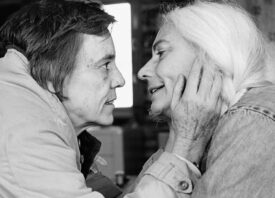
If you are lucky, you get old is London-based photographer Freya Najade’s series of intimate vignettes exploring the life stories of her elderly subjects. Najade captures the present while listening to the past, reminding us that some things never change—to love, to suffer, and to dream are forever lasting.

Freya_Najade_Photography Thelma’s Boot. My biggest fear is that I can’t take care of myself anymore. This is what keeps me going. Every day.

Freya_Najade_Photography Thelma’s Vase. I fell in love for the first time four years ago. With Swede I had my teenage years, which I never had. He has the prettiest blue eyes. When he walks through my door, my whole body just warms up. This is a beautiful feeling, but when he is not there it is a terrible feeling. I had my first orgasm with him.

Freya_Najade_Photography Thelma. One day Swede went to see his son for seven weeks. The seven weeks turned into seven months. I got really ugly with him then. When he came back he didn’t want to touch me anymore.

Freya_Najade_Photography Squirrel. Things got difficult when we stopped agreeing. Once I started having my own say about things, Swede would go home. People often don’t realize that everyone sees things differenty. This can be a problem.

Freya_Najade_Photography Desert. My children can’t understand me. They are not proud of me. But I hope one day they will remember me as a nice old lady.

Freya_Najade_Photography Thelma at a Dance. Slowly I am getting to the point, that I feel I have to move on. I am not a fool just waiting around. If Swede doesn’t want me, I will get around without him.

Freya_Najade_Photography Chris in his Bedroom. I am happy with my life. I have now been with my partner John for 36 years. It was not always easy, but definitely worth it.

Freya_Najade_Photography Chris’ Photo Album. John and I went through a lot together. In the 1980s we experienced how almost a whole generation of gay men got wiped out by Aids. Many of our friends in these pictures died within three years.

Freya_Najade_Photography Chris and John. I was married to a woman for thirteen years. I had seven children with her. I am not only proud of them, but also that John and I raised them together.

Freya_Najade_Photography Flamingo

Freya_Najade_Photography Chris and his Dog. To lose my legs was not as difficult as I thought, my divorce and to admit that I am gay was much more difficult for me. But everything that is difficult in life makes you stronger.

Freya_Najade_Photography At the Dinner Table.

Freya_Najade_Photography Chris and John in the Pool. When I saw John for the first time, I knew my ship had arrived. Meeting him was the best thing in my life.

Freya_Najade_Photography At the Gay Church. Ending a relationship is very easy. So many people just walk away from it, while with a little work they just could have stayed together. You have to grow together.


Fadwa, 20 years old, widow with 3 children: "My husband died on the front lines, I will die on the front lines, may God help us."

Photographer Sebastiano Tomada Piccolomini brings us more great work from the forefront of the Syrian conflict, this time showcasing women from an all-female fighting unit of the Free Syrian Army based in Aleppo. Strong and with conviction, the women stand ready.

Khansa, 42 years old, married, housewife with 7 children: “I feel optimistic, we will defeat the regime, put an end to poverty and mistreatment.”

Om Ahmad, 72 years old, housewife with 3 children: "My house in Dar’a was destroyed by 2 bombs…I moved to Aleppo with my family, I chose to pick up a weapon and fight the regime.”

Rana, 20 years old, student: "What choice do we have?”

Om Faraj, 30 years old housewife, no children: "Being mistreated by a regime security guard in front of my husband was the most humiliating thing that has ever happened to my family, I picked up a weapon, I joined the fight."

Amal, 30 years old, married, housewife with 3 children: "I'm sincere to God, that is all I need and want, the rest will come with time.”

Ali, 16 years old, student: "The West sees no problem in Syria, while we beg for their support, our children, friends and family are being punished, for no reason."

Benifet Ikhla, 27 years old, widow with 6 children: "I fight for life and freedom, I fight to prove that woman and man are equal."

via TIME

Ayaka_Yamamoto_photography

Japanese photographer Ayaka Yamamoto’s portraits play with the idea of identity; not so much with how one is created but rather how one is stripped away. In 2009, Yamamoto traveled to Estonia and Latvia in Northern Europe to capture these shots—lands that were far different from her own. She says the language barrier and unfamiliar culture enabled her to view her subjects as “new beings”, free of information and context built up over time. They are presented as mysterious and intriguing, almost in a state of transition—it’s hard to discern where they’ve been or where they’re headed.

Ayaka_Yamamoto_photography

Ayaka_Yamamoto_photography

Ayaka_Yamamoto_photography

Ayaka_Yamamoto_photography

Ayaka_Yamamoto_photography

Ayaka_Yamamoto_photography

Ayaka_Yamamoto_photography

Melissa_Cacciola_Photography

Melissa_Cacciola_Photography

New York based photographer Melissa Cacciola recently talked to us about War and Peace, a series of tintype portraits of active duty military and veterans. The work is currently on display at United Photo Industries in Brooklyn through April 27th, 2013.

How did you select the active duty military and veterans that you shot for this series?
“I began by calling, writing, and e-mailing five government branches, my local congressman, and by visiting recruiting offices. Without having connections or contacts, finding willing subjects could have been an impossible process. It really wasn’t until I made contact with two Marines that things began to move forward.

“The United States Coast Guard, Navy, Army, and the Wounded Warrior Project gave me their full support so that I could get access to the people I needed. So many people trusted me without knowing me or about my work. I could not have told their story otherwise.”

Melissa_Cacciola_Photography

Melissa_Cacciola_Photography

Was there a specific reason that you chose to document the military using tintype?
“I began War and Peace during the anniversary year of September 11th as a way of reflecting on how this event impacted the nation and New York City. We have been a country at war in Iraq and Afghanistan for over twelve years now and many of the people I photographed for my project enlisted because of 9/11. We often talk about warfare in technological terms, but there is a human side to it. I wanted to create intimate portraits. And considering the origin of tintyping, it was also a unique opportunity to explore the rich history of the tintype and its beginnings documenting the Civil War.”

Melissa_Cacciola_Photography

Melissa_Cacciola_Photography

What was the conversation with the subjects like regarding the non-military version of their portraits? Did they choose what they would wear themselves?
“I asked my subjects to make their civilian portrait as personal as possible in an effort to connect with the viewer. Each person put a great deal of thought into his/her portrait. Ray, a U.S. Coast Guard officer, wore a guayabera in honor of his Puerto Rican heritage while Edward wore a business suit to symbolize his re-entry into the non-military sector of commerce from the U.S. Marine Corps.

“Each little detail you see in the civilian portraits carries a great deal of weight and meaning. Much like Roland Barthes’ punctum, there are layers to explore within a single gesture. In contrast, the military portraits had to be so structured because of rules governing how uniforms could be worn, from the angle of a cover or hat to the polish of buttons on the jackets.”

Melissa_Cacciola_Photography

Melissa_Cacciola_Photography

Your bio says that you studied historic preservation of fine art, how do you think that created and influenced your perspective as a photographer?
“Having a background in fine art means that I’m always looking at art—whether it be Velasquez’s paintings of the Spanish court, Bill Viola’s transformative video installations, or the photographs of August Sander. Often at a microscopic level, I’m investigating brushstrokes in a painting or the gelatin reticulation pattern in a print. Tintyping brings together my interests in history, process, and chemistry.”

Melissa_Cacciola_Photography

Melissa_Cacciola_Photography

How did you first start working in tintype? You studied some tintype techniques with John Coffer but what first interested you in the process?
“I fell in love with tintyping during a class in historic preservation at the Metropolitan Museum of Art. We were studying tintype portraits from the Civil War. They were so powerful and haunting I couldn’t stop thinking about them. That was what brought me to study with John Coffer and embark on my own with the technique.”

Since the original idea of the tintype was to show the subject their image right away, was this something you did with your subjects?
“Absolutely. Everyone that comes to the studio for a portrait ends up in the darkroom seeing his/her portrait materialize in the fixer. It’s pure magic every time. I never get tired of or take this very intimate and special moment for granted.”

This post was contributed by photographer Laura Barisonzi.

Sage_Sohier_Photography

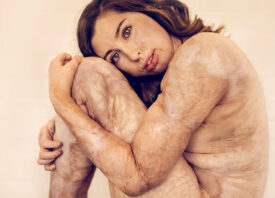
Most people I photograph are acutely aware of their imperfections and try to minimize them. Some have confided in me that, in their attempt to look more normal, they strive for impassivity and repress their smiles. They worry that this effort is altering who they are emotionally and affecting how other people respond to them. While most of us assume that our expressions convey our emotions, it seems that the inverse can also be true: our emotions can, in some ways, be influenced by our facial expressions.—Sage Sohier

For the past three years, Massachusetts-based photographer Sage Sohier has spent time in a facial nerve clinic in Massachusetts capturing portraits of people with facial paralysis caused by either Bell’s palsy, tumors, strokes, accidents, or congenital nerve damage. About Face offers what the photographer says is a fascinating view of two expressions at once, while honoring the courage required for one to cope with medical afflictions.

About Face opens at Foley Gallery in New York on April 17th and will remain on view through May 24th, 2013.

Sage_Sohier_Photography

Sage_Sohier_Photography

Sage_Sohier_Photography

Sage_Sohier_Photography

Sage_Sohier_Photography

Sage_Sohier_Photography

Sage_Sohier_Photography

Sage_Sohier_Photography

Alla_Mirovskaya_photography

I want to sense the warmth of her heart anew, like in my childhood; to look closer and get to know my present, mature mother. To fixate, to remember, to feel acutely the moments of the life that I treasure, which is primordially a source of my own. Wise and not so wise, powerful and weak, young and mature, good and bad—anything she may be. My mom. Distant no more. Close…again.
Alla Mirovskaya

Driven by an inner motivation to comprehend her family reality, Russian photographer Alla Mirovskaya explores the complex relationship between mother and daughter in Distant and Close, a series that reads just like it sounds. She weaves together an intimate narrative through nostalgic, light-soaked images that explore identity, personality and kinship. Mirovskaya spent a year working on the project, navigating the waters of the familial great divide and connection—a documentary process she says prompted a rediscovery of her own worldview.

Alla_Mirovskaya_photography

Alla_Mirovskaya_photography

Alla_Mirovskaya_photography

Alla_Mirovskaya_photography

Alla_Mirovskaya_Photography

Alla_Mirovskaya_Photography

Alla_Mirovskaya_Photography

Alla_Mirovskaya_Photography

Alla_Mirovskaya_Photography

Alla_Mirovskaya_Photography

Riitta_Ikonen_Photography

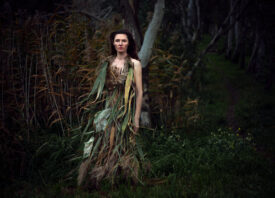
Eyes as Big as Plates is an ongoing collaborative project by Finnish artist Riitta Ikonen and Norwegian photographer Karoline Hjorth inspired by Scandinavian folklore, said to be “the clearest reflection of the soul of a people.” The first stage of the work captures Norwegian natives—sailors, farmers, professors, artisans, teachers and parachuters—while the second explores Finnish folklore. The duo intentionally uses elderly subjects and fuses them with the existing land. A nod to the mythical protagonists of yore, the portraits honor a connection to nature and suggest a return to the earth.

The most recent extension of the project has brought them to New York for Recess‘ signature program Session that invites artists to use their storefront as a studio, exhibition venue, and an experimental playground. During their residency, which runs through April 26, Ikonen and Hjorth will create costumes, settings, and performance programs for New York seniors who identify with their national and cultural roots.

Riitta_Ikonen_Photography

Riitta_Ikonen_Photography

Riitta_Ikonen_Photography

Riitta_Ikonen_Photography

Riitta_Ikonen_Photography

Riitta_Ikonen_Photography

Riitta_Ikonen_Photography

Riitta_Ikonen_Photography

Riitta_Ikonen_Photography

Thanks Gabriela Herman for the tip.

mariette-pathy-allenPaula and Daughter, Rachel

It was 1978 in New Orleans on the last day of Mardi Gras when photographer Mariette Pathy Allen happened upon a group of crossdressing men in a hotel—a chance encounter that would lead to a multi-decade exploration of the transgender community. Shot throughout the 1980s, Transformations compiles portraits of crossdressers in their homes and with their loved ones in an attempt to offer society a different view of a group that had been quite mis-characterized at the time. Allen was a pioneering powerhouse at the inception of this work, which was published into a book in 1989. She has since continued to inspire gender consciousness with the publication of her second book, The Gender Frontier that compiles photographs, interviews, and essays exploring political activism and transgender youth. Allen has also been a valuable consultant to several films about gender and sexuality over the years.

marietteChange shoes, change gender

mariette-pathy-allenBeth and her husband, Rita, near Boston

mariette-pathy-allenSheila, crying in church, Provincetown, MA

mariette-pathy-allenVicky doing the can can with Cori and Julia, L.I., NY

mariette-pathy-allenDavida and Diane, couple

mariette-pathy-allenRachel, watching her father transform into Paula, Philadelphia

mariette-pathy-allenJoanne and sister, Claudia

mariette-pathy-allenDan and Yvonne, reversed couple

mariette-pathy-allenPajama party

mariette-pathy-allenLine up, Mardi Gras, New Orleans. The moment I started on my exploration.


robert_rutoedPhoto: Robert Rutoed

photoville fence

renecervantes_photography

I went to the agave fields to shoot the jimadores on their schedule and under their terms. Every situation was different but everyone was kind and respectful, though doubtful at times.

There was one occasion I ended up meeting some illegitimate jimadores and they took me to an illegal distillery. I spent four days trying to shoot at the distillery (which the person in charge said I could do) but every time we were invited to come, somehow the place was deserted and on lockdown. It was a bit frustrating but it was obvious to us why they wouldn’t want to be photographed. The curious part of it all was that we were never told not to come back.

My homebase for the trip was Guadalajara which is only a 45 minute drive from the agave fields. Before going there I had no contacts at all. I speak the language and took a big gamble on doing it this way. I didn’t want to be shown what every tourist is shown. Any time you do something like this it is easy to find local people to help you and make your work easier, but most likely they will point you to what they think you should be looking at (or what every tourist wants to see) and not to what you are searching for.—Rene Cervantes

Photographer Rene Cervantes explores Mexico’s agave harvesting fields in his recent project, Jimadores. He grew up on the Texas/Mexico border in El Paso and Ciudad Juarez and spent his teenage years and early 20’s playing in bands before leaving to California to study photography at the Brooks Institute. He is now based in New York.

renecervantes_photography

renecervantes_photography

renecervantes_photography

renecervantes_photography

This post was contributed by photographer Matt Rainwaters.