Posts tagged as:

landscape photography

David_Burdeny_Photography

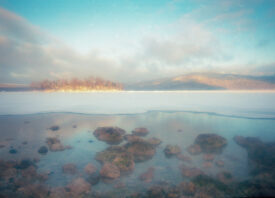
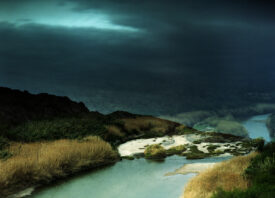
David Burdeny’s graphic Drift series began while he was studying for a degree in architecture in Canada. Inspired by Mark Rothko’s multiform paintings, the series began as a study in landscape and space, using seasonal color and the horizon as the basis of the project. The initial shots were taken near his home in Winnipeg, Canada, but extended across the oceans to England, France and Japan.

The photographs are all of bodies of water, shot with film. The ‘blur’ effect is created directly in-camera using a Roundshot panoramic camera that modified the film internally while the body remained motionless. This technique created a horizontal ‘smearing’ of any stationary objects in the frame, similar to the effect a photo-finish camera has in sporting events. Burdeny found that shooting in areas with strong lighting and heavy contrast produced the best results. The final images are essentially digital prints, but as Burdeny says, although the effect could be created in Photoshop, he prefers to create the blur in-camera, which he believes creates a softer, yet stronger effect.

David_Burdeny_Photography

David_Burdeny_Photography

David_Burdeny_Photography

David_Burdeny_Photography

David_Burdeny_Photography

David_Burdeny_Photography

David_Burdeny_Photography

Feature Shoot Contributing Editor Carolyn Rauch is the Deputy Director of Photography at Newsweek.

Ryann_Ford_Photography
Near Big Bend National Park, Texas

All over the country, rest areas are losing the fight to commercial alternatives: drive-thrus at every exit and mega-sized travel centers offering car washes, wi-fi, grilled paninis and bladder-busting sized fountain drinks. Louisiana has closed 24 of its 34 stops, Virginia, 18 of its 42; pretty much every state in the country has reduced its number of rest areas, or at least cut operating hours. And they’re not just being closed, they’re being demolished.

For the past 53 years, rest stops have given us rest, relief, hospitality and nostalgia. They have been an oasis of green to walk your dog, have a picnic, study the map. We can all relate to rest stops and what they represent as social and architectural icons of Americana. To me though, they are disappearing waysides of memories, anticipation and mystery of what the next one down the road will look like.—Ryann Ford

Austin-based photographer Ryann Ford honors the charm of roadside rest stops throughout the U.S. in her series Rest Stops: Vanishing Relics of the American Roadside. Inspired to systematically document them before they disappear, Ford creates a typological highlight of their architecture, environment, and spirit.

Ryann_Ford_Photography
White Sands National Monument, New Mexico

Ryann_Ford_Photography
Near Burleson, Texas – I-35

Ryann_Ford_Photography
Galveston, Texas

Ryann_Ford_Photography
Walker Lake, Nevada – U.S. 95

Ryann_Ford_Photography
Near Thackerville, Oklahoma – I-35

Ryann_Ford_Photography
Monument Valley, Arizona

Ryann_Ford_Photography
Petrified Forest National Park, Arizona

Ryann_Ford_Photography
Near Abiquiu, New Mexico – U.S. 84

Ryann_Ford_Photography
Juan Santa Cruz Picnic Area – Tucson, Arizona

Ryann_Ford_Photography
Near Augustus, Texas – U.S. 84

Ryann_Ford_Photography
Saguaro National Park, Arizona

Ryann_Ford_Photography
Anthony, New Mexico – I-10 – New Mexico/Texas Border

If you’re a photographer, you can now promote your new series, website, gallery show, recent assignment, etc. on Feature Shoot for an affordable price. Find out about becoming a Spotlight Photographer here.

Graham_Miller_Photography

Austrailian-based photographer Graham Miller combines constructed portraits, documentary street portraits, landscapes and still lifes in a series named after the 1992 Leonard Cohen song, Waiting for the Miracle. Miller explores narratives created through the interplay of these images and the connections made between them. While this results in an open ended and ambiguous experience, the images seem to hold compelling stories within the fictional coastal town Miller has constructed. Miller echoes the words of photographer Robert Adams in his statement, speaking of the young protagonists that “cling precariously but tenaciously to a sense of possibility, hope, and resolve.”

Graham_Miller_Photography

Graham_Miller_Photography

Graham_Miller_Photography

Graham_Miller_Photography

Graham_Miller_Photography

Graham_Miller_Photography

Graham_Miller_Photography

Graham_Miller_Photography

Graham_Miller_Photography

Graham_Miller_Photography

Florian_Reischauer_Photography

Grüß Gott – a fairy tale is a project by Austrian-born, Berlin-based photographer Florian Reischauer in which he revists his childhood home, a small village in Austria—a place that now seems surreal to him. Endless waves of grain and verdant pastures combine with fairy tale-like characters as he explores memory, tradition, and the cycle of time in a narrative that seems to remain quite open-ended.

Florian_Reischauer_Photography

Florian_Reischauer_Photography

Florian_Reischauer_Photography

Florian_Reischauer_Photography

Florian_Reischauer_Photography

Florian_Reischauer_Photography

Florian_Reischauer_Photography

Florian_Reischauer_Photography

Florian_Reischauer_Photography

Florian_Reischauer_Photography

David-Maisel_Photography
Terminal Mirage 18, David Maisel/INSTITUTE

Black Maps is San Francisco-based photographer David Maisel’s new book of over 100 photographs spanning his career. The book combines various aerial projects documenting environmentally impacted sites; land that has been transformed and altered by industrial efforts—mining, logging, water reclamation, and military testing.

Maisel’s photographs are stunning in their beauty and challenging in their reveal. They capture the complex relationship between the natural world and the humans that intervene; a relationship that forever begs for balance. Maisel describes the sites as “contemplative gardens of our time, places that offer the opportunity to reflect on who and what we are collectively, as a society.”

Published by Steidl, Black Maps will be released on April 1, 2013.

David_Maisel_PhotographyTerminal Mirage 2, David Maisel/INSTITUTE

David-Maisel_Photography
Terminal Mirage 5, David Maisel/INSTITUTE

David-Maisel_Photography
The Lake Project 16, David Maisel/INSTITUTE

David-Maisel_Photography
Terminal Mirage 24, David Maisel/INSTITUTE

David-Maisel_Photography
Oblivion 18n, David Maisel/INSTITUTE

David-Maisel_Photography
American Mine (Carlin, NV 1), David Maisel/INSTITUTE

David_Maisel_Photography
The Mining Project (Butte MT 3), David Maisel/INSTITUTE

David-Maisel_Photography
Terminal Mirage 15 (Robert Smithson’s Spiral Jetty), David Maisel/INSTITUTE

David_Maisel_Photography
The Lake Project 20, David Maisel/INSTITUTE

David-Maisel_Photography
Black Maps (Bingham Canyon, Utah 2), David Maisel/INSTITUTE

David-Maisel_Photography
American Mine (Carlin, Nevada 22), David Maisel/INSTITUTE

David-Maisel_Photography
Terminal Mirage 17, David Maisel/INSTITUTE

Takeshi-Suga

Although I’ve been remotely inspired by the song Winter Wonderland, my main focus is to explore the idea of a wonderland in wintertime Japan. Winter in Japan can be extremely harsh but I seek moments of euphoric serenity that it also offers every now and then. That’s where I believe Winter Wonderland resides.—Takeshi Suga

It’s almost as if we’re looking through snow-dusted glasses at Japanese photographer Takeshi Suga’s new series. Serene and quiet, Suga brings a warming glow to his wintery landscapes.

Now based in Kobe, Japan, Suga lived and worked in the UK until 2012 working predominantly for NME, shooting on the road with bands Mogwai, Frank Turner and The Wombats. His personal work is often whimsical and delicate.

Takeshi_Suga_Photography

Takeshi_Suga_Photography

Takeshi_Suga_Photography

Takeshi_Suga_Photography

Takeshi_Suga_Photography

Takeshi_Suga_Photography

Takeshi_Suga_Photography

Takeshi_Suga_Photography

Takeshi_Suga_Photography

photoville fence

Peter-HoffmanPhoto: Peter Hoffman

The topic for the next Feature Shoot online group show will be photos of foggy landscapes.

Photographers are invited to submit images and captions to:
submissions@featureshoot.com

Up to five images can be submitted (480 pixels wide, 72 dpi, saved for web under 65kb). The deadline for submissions is March 22, 2013.

Amanda-Areias_photography
Photo: Amanda Areias

William-LeGoullon_photography
Photo: William LeGoullon

Ahmer-Inam2_photography
Photo: Ahmer Inam

David-Kimelman_photography
Photo: David Kimelman

Miisha-Ayana_photography
Photo: Miisha Ayana

Maxime-Guyon_photography
Photo: Maxime Guyon

Matt-Whitby_photography
Photo: Matt Whitby

Ted-Morrison_photography
Photo: Ted Morrison

JosniBelanger_photography
Photo: Josni Belanger

Jana-Mare_photography
Photo: Jana Maré

Amanda-Mustard_photography
Photo: Amanda Mustard

Lyle-F-Wented_photography
Photo: Lyle F Wente

phil-rosenberg_photography
Photo: Phil Rosenberg

Kalian-L_photography
Photo: Kalian Lo

Georgia_Lloyd_photography
Photo: Georgia Lloyd

Gabriele-Harhoff_photography
Photo: Gabriele Harhoff

Eoin-McLoughlin_photography
Photo: Eoin McLoughlin

Cale-Kehoe_photography
Photo: Cale Kehoe

cyndilong_photography
Photo: Cyndi Long

Ashley_Kauschinger_photography
Photo: Ashley Kauschinger

TroyFarah_photography
Photo: Troy Farah

Brian-James-Kip_photography
Photo: Brian James Kip

Ashley_Kauschinger_photography
Photo: Ashley Kauschinger

Alejandro-Santiago_photography
Photo: Alejandro Santiago

Alejandra-Carles-Tolra_photography
Photo: Alejandra Carles Tolra

*This show was curated from reader submissions.

Myoung_Ho_Lee_photography

Myoung Ho Lee photographs solitary trees framed against white canvas backdrops in the middle of natural landscapes. To install the large canvases, which span approximately 60 by 45 feet, the artist enlists a production crew and heavy cranes. Minor components of the canvas support system, such as ropes or bars, are later removed from the photograph through minimal digital retouching, creating the illusion that the backdrop is floating behind the tree.—Yossi Milo Gallery

Tree is South Korean photographer Myoung Ho Lee’s beautiful series of a variety of trees captured with a 4×5 camera in different seasons and locations. Lee’s placement of the backdrop extracts the tree from its vast surrounding landscape, highlighting its beauty and uniqueness. He plays with perspective and scale, the tree becoming as separate as it is part of the whole. A meditative calm seems to float through the air in Lee’s refashioned landscapes.

Lee is represented by Yossi Milo Gallery in New York.

Myoung_Ho_Lee_photography

Myoung_Ho_Lee_photography

Myoung_Ho_Lee_photography

Myoung_Ho_Lee_photography

Myoung_Ho_Lee_photography

Myoung_Ho_Lee_photography

via Art Buyers Are People Too

Nathan_Wirth_photography

Nathan Wirth is a San Francisoco-based fine art photographer. Many of his images of stark landscapes in and around the San Francisco Bay area were taken with an Infrared-modified DSLR, yielding stunning results. Wirth’s landscapes are serene, inviting, thoughtful. He recently talked to us about process and technique.

Do you shoot film infrared or do you shoot with a modified for infrared digital camera?
“My first experiments with infrared were with a Sony Alpha 700 DSLR and Hoya’s R72 infrared filter. The filter is very dark and even on a bright day with a fairly wide aperture it takes at the very least, several seconds. I really liked playing with long exposure infrared shots, but with my available lenses, the exposures of a second or more often produced a very annoying hot spot in the center of the image that was quite difficult to work around, so I eventually modified my first DSLR, a Sony Alpha 100, so I could easily take handheld shots and not have to deal with those annoying hot spots.”

Nathan_Wirth_photography

How do you previsualize what the infrared pictures will look like before you take them?
“When I had my camera modified by lifepixel, I chose their Deep BW IR filter (equivalent to an 830nm filter), which in general produces very stark contrasts between the blacks and the whites. The typical “look” of most infrared images highlights and exaggerates the snowy white vegetation, giving it a glow, so much so that for my tastes, it becomes far more about the gimmick than the composition, the mood, or the tone, which are the things that I am most concerned with. I strive to find the warmest, strongest tonal qualities possible, so I tend to downplay that eggshell white so often associated with IR images.

“I previsualize what I want by anticipating what those contrasts will likely be—and the rest of the vision and processing comes down to working with a composition that does not rely on the gimmick. I don’t want a “fantasy world” image. I want to create something that has warm, engaging tones, something with a sprinkle or two of yellow to bring out the warmth of those tones. In other words, I want to use the infrared to complement the mood, not define it.”

Nathan_Wirth_photography

Nathan_Wirth_photography

You have mentioned that you like shooting without thinking too much, without expectation and analysis. How does this type of technique work with long exposures? Is there a lot of trial and error in your process?
“The true allure for me in both long exposure and infrared photography is the element of surprise. No matter how good I have gotten at anticipating what I will get, I still from time to time end up with these remarkable nuances of light and shadow that I had not anticipated. That said, with practice I have gotten to the point where I can more or less guess what I will get and what weather conditions and quality of light will yield which tones and how long an exposure needs to be to get a desired effect.

“Initially, I had to go through a lot of trial and error, but now these matters are part of my toolbox. I don’t wander around for long periods of time trying to measure and calculate the best composition. Instead, I usually just see it and go from there. I let the mood, light, and moment dictate where I will go and what I will do. I typically photograph by myself, and that quality of solitude plays an important role in what I am trying to express and how I go about doing it.”

Nathan_Wirth_photography

What time of day and weather conditions do you prefer to shoot this work in?
“In general, I prefer cloudy days. My favorite conditions are usually found in-between rain storms, when those dark clouds are moving and the sunlight is bursting through the various openings that come and go with the movement. I especially love those days when the clouds are dark, but the sun is out and illuminating the sea, the rocks, the bridge, the building or other features of a cityscape, landscape, or seascape. I prefer the light found during sunrise and sunset, both for my infrared and my long exposures. There is an undeniable warmth to that light that transfers well to both monochrome long exposures and infrared shots.”

Nathan_Wirth_photography

You mention that a lot of your work is done in an improvisational way. Can you expand on that?
“When I speak of improvisation, I am thinking about a state in which I let my mind go while I process and just work my way through the image as it seems fit, and if even possible, to remove my ego and expectations and worries about how an image will be potentially received. It is very easy to get in one’s own way when processing an image—or even when choosing what to photograph. Second guessing can be stifling and relying on a set group of presets or tried and true processing maneuvers can be limiting.

“I also find tones and contrasts without approaching the image from a preconceived notion of what a seascape, landscape, architectural shot ’should look like’ and, instead, I am willing to discover the image by simply exploring the possibilities. I am not, however, saying that I just float around willy-nilly or aimlessly and wait to see if something happens. I just don’t overthink what I am doing. I simply just do it by letting the process unravel in the moment.”

Nathan_Wirth_photography

This post was contributed by photographer Laura Barisonzi.