Posts tagged as:
advertising photography
John Fulton was recently named a Luerzer’s Archive Top 200 Advertising Photographer Worldwide, and his work has been recognized globally by the likes of Hasselblad Masters, Ads of the World, Canon, “Lucies” (The Int’l Photography Awards), The Addy’s, and Prix de la Photographie Paris, among others. He is based in Savannah, Georgia and represented by Visu Artists and Wonderful Machine.
Your work encompasses a range of things from portraits to advertising work to editorial images – how did you get started, and is there a genre you prefer working in most?
‘I went to photography school in Santa Barbara, California. After graduation, I was hired at a retouching house in San Francisco, worked on some big campaigns, and learned how the back and forth with art directors is conducted successfully. While in SF, I also worked with Jim Erickson, Erik Almas, and a bunch of other great people. The skills and business acumen that I learned during that time had a big influence on me.
‘I’m inspired and interested in a lot of different things, but I specialize in photographing people, environments, and concepts whether personal or commercial. I shoot projects outside of those categories but have other venues and outlets for that kind of work. I would get bored shooting the same things all the time. Photography is a great tool that way – it can applied in so many ways.’
You recently completed a series of extreme runners after a race – can you talk a bit about these images?
‘From time to time I take on editorial assignments from a small magazine here in Savannah for fun and to stay fresh. They approached me about shooting something they called “extreme running”. This sport basically entails athletes swimming through mud pits and running straight through the swamp. It sounded intriguing. When I arrived on location, the owner of the course explained that it was required that his course be inspected by an alligator expert and steps had to be taken to ensure that an athlete doesn’t find him or herself face to face with a ten footer in the middle of a race. “It’s 99% gator free!”, the owner said with a big smile and no sense of sarcasm in his voice. I tried not to think about that 1% when I was up to my chest in the swamp shooting.
‘Originally, I’d thought that the best images would be the action on the course. It was a great experience shooting the actual race but when it came time to edit, it was these portraits that I found to be the most engaging. I was very happy with the final series and they’ve been well-received by ad agencies.’
A lot of your advertising and creative work has a rather unique and somewhat playful feel. How do you think digital editing and manipulation affects the images you produce?
‘Post production plays a role in most of my work. When capturing everything in camera isn’t possible due to budget or logistical constraints, there’s often some compositing involved. At minimum, I will massage the tones and colors to see what palette I think is most affective for the environment. I’m also visually excited by atmosphere, dust, fog, smoke, etc. I usually weave a little atmosphere into the image even if it’s subtle. To me, post production is just another tool to help make the images in my head come alive in a tangible form. It feels like a combination of photography and painting which I really enjoy.’
Do you find that you approach a project differently if it’s shot on location rather than in a studio environment?
‘Even with a scout, location work always has many potentially uncontrollable elements involved compared to the studio in my experience. Inclement weather, changing light, random people upset that you get to shut part of their street down despite your permit, there’s always unexpected challenges. Thinking on your feet is a prerequisite for location work. Having a great producer who helps put out fires behind the scenes really helps as well.
‘Last year, while planning a shoot in a neighborhood, some random person took it upon themselves to dial up and leave nasty messages about my production to the agency, their parent agency, and the client. It turned out the guy didn’t even live in the neighborhood. My producer took care of the problem over the course of several days, but it could have gone badly and that was even before the shoot started.
‘To answer the original question, when planning a location shoot I’m of the mind that you can’t over think or over plan the production but you have to be ready for when things change. My studio work is much more straight forward so generally, all I need is to have a vision for what the final work will look like and know how to get it there.’
Your image of the hula girl on the dashboard for ‘Eaton’ has been hugely successful – where did the idea for that shoot originate?
‘The elderly hula girl was a great project. It was concepted by the agency (Brunner) who I’ve worked with for several years. It’s been so successful for the client, that they’ve had real elderly hula dolls fabricated in China for their promotion and branding.’
This post was contributed by Ariel Body.
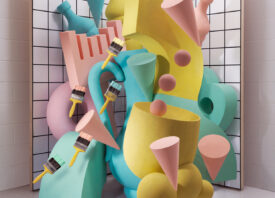
This work is from a campaign for chinaware brand Mateus. The set designer, Anton Thorsson, and I got free rein to create the concept for the campaign. The environments are all made of paper and we wanted to create a dreamlike feeling to them which we enhanced by using smoke as fog.
Swedish still life and advertising photographer Niklas Alm started exploring the world of photography as a kid in his parents darkroom. Since 2001, he has been working with both editorial and advertising commissions; creating interesting environments and images with a character of their own.
Oli Kellett is a London-based photographer who earned his degree from St. Martins Art College. He worked at several London ad agencies as an art director before leaving in 2008 to pursue photography full time. His recent project is entitled ‘Team Vodkovia’ and features a digitally-designed team of olympic hopefuls from the fictitious country of Vodkovia.
What was your vision and inspiration behind the Team Vodkovia series?
‘The idea for “Team Vodkovia” started in the spring of 2011 when Olympic fever was really beginning over here in London. I thought it would be good to get involved and would be fun to invent some athletes who were specifically matched to the event they would participate in. Brave New World Style.’
You worked closely with retouchers, writers, designers, etc. to create the whole visual story. Can you talk a little about that process?
‘We started thinking about athletes and events and I was sending ideas through to Kai, a retoucher at The Operators, who was letting me know what was possible.‘Eventually we settled on eight athletes and spent a long weekend shooting them in a studio in North London. After the shoot, The Operators started the retouching job which meant a lot of arms and legs of different bodies stitched onto new ones.
‘At about this point I thought about how I could get the images out to creatives and Art Buyers and get the series a bit of PR. I thought to create a “Top Trump” themed mailer and I started brainstorming fictitious background information for each athlete.
‘When the images were almost ready, I got in touch with a couple of graphic designers I knew and a writer. It was important that I had the images nearly done so I could get them excited about the idea. Luckily they liked it and we all agreed it had the potential to go bigger; it could be an entire country, and this was their first Olympic games. Three months later “Team Vodkovia” was born and is ready to take on the world.
‘Writing and design was done by Konstantinos Kanellopoulos, and the website was designed by Kostja Paschalidis. There is also a poster which is going to be sent out to advertise the country.’
What has the feedback been like so far?
‘I was asked to do a presentation of my work in December so I took that as a good opportunity to launch “Team Vodkovia”. I got an actor to play the President of Vodkovia. I dressed him up and he gave a rousing and enthusiastic speech introducing each of the athletes and their background. I don’t think anyone was expecting it but I think it went down well.’
How do envision it evolving as it gets closer to the Olympics?
‘What I would love is for some print and online magazines which are not art/photography related to run the images. It would be great if the project could cross over into the ‘real’ sports world as a bit of fun. That’s when I will consider the project to be a success.’
The whole idea of the series is really quirky – from the images themselves to the online shop to physically designing an entire country – is there some kind of message or statement you’re trying to make through the images and intricacy of the project as a whole?
‘Well the project didn’t start off this big. It was originally just a sketch of a guy with long legs riding a bike, but has grown quite naturally along the way. There is no message as such, just meant to be a bit of entertainment. I feel people remember ‘the idea’ more than the images (in most photography), so the more work I can put into ‘the idea’, like the biographies and shop, I hope will result in more people remembering the project.’
This post was contributed by Ariel Body.
Photo by Ryan McGinley for Edun
Rob Steel is a London based commercial photographer with a skewed view of the world. Some of his clients include Swatch, American Express, Playstation 2 and Kellogg’s. He is represented by Metcalfe Lancaster in London.
Since starting out as a photographer’s assistant in Europe, Danish-born beauty photographer Kenneth Willardt has come to dominate the world of American beauty photography. Along with work for clients such as Christian Dior, L’Oreal Paris, Neutrogena, Nivea and Target, he has been producing images for the worldwide Maybelline print campaigns since 2006. He was recently commissioned to create TV spots for Maybelline, which, combined with his use of Red camera technology, further expanded his technical and commercial repertoire. His editorial work has been published in many publications including Allure, A Magazine, Chinese Vogue, German Vogue, Spanish Vogue, Brazilian Vogue, US Glamour, British Glamour and GQ. This shoot was for the Maybelline 2011 Calendar, which is a small edition distributed to the top 500 worldwide magazine editors.
THE CREW:
Fashion Stylist: Michael Angel
Production Designer: Andrea Stanley
Models: Julia Stegner, Kemp Muhl, Emily Didonato, Erin Wasson, Shu Pei, Lisalla Montenegro
Hair Stylist: Stephane Lancien
Makeup: Charlotte Willer
Manicurist: Jin Soon
Location: Pier 59
What was the inspiration behind the calendar?
‘The inspiration was a glimpse into the lives of women living in a New York apartment building. 2012’s inspiration will be women at work’.
How long have you been shooting the calendar for Maybelline?
‘This is the fourth year we are shooting it and it has been a great project. It’s a bit of a dream for a photographer. We have about 100 editors and journalists from all over the world coming on and off set so there is a lot of excitement and energy in the air. They are constantly interviewing the crew and models’.
How was the experience different this year?
‘This year (2012 calendar) was very exciting because we filmed footage for an internet iPad app’.
Was this shot over multiple days?
‘This was shot over three days with four build days and two pre-lights’.
How was the crew chosen? Do the same people work on the calendar each year or do you switch it up depending on the theme?
‘Gotham and Maybelline have the final say but we always have a creative discussion about it. Over the years we have been dubbed “the dream team”. We are usually the same crew as long as there aren’t any conflicts with shoot dates’.
Before becoming a professional photographer, Matt Hoyle was a Creative Director in advertising. His photography has been recognized in Communication Arts, PDN Photo Annual, and D&AD. He’s been selected as one of the 200 Best Ad Photographers by Lurzer’s Archive, and has appeared multiple times in the IPA Best of Show. His work has also won a Cannes Gold Lion. Matt’s clients include Saatchi & Saatchi, BBDO, GSD&M, Rolling Stone, New York Magazine, Wired and Fast Company among others. This work is from his new personal series, Barnumville.
Your most recent series, Barnumville, depicts a city inhabited by sideshow performers. What inspired this continuation of your previous series, Barnumvillians, in which you shot portraits of said residents?
‘I’ve always thought of myself more in terms of creating stories. Having been a copywriter in advertising I was used to conveying sentiments in terms of words and narratives so it never feels quite right shooting something without trying to get something beyond an aesthetic. With Barnumville, I knew circus freaks and sideshow performers where inherently interesting for a simple black and white, with their unique physicality. But I also loved this mythic world of the sideshow which is actually based on reality. Before it was politically incorrect to make a living off or ones so called deformities or uniqueness it was actually one of the mainstays of entertainment. Barnum was one of the world’s greatest showmen with his stable of stars. I wanted to base this series on a ‘what if’. What if there was a town totally inhabited by these special people. How twisted would it be’?
Your portrayal of Barnumville is the result of blending elements of reality with your fictitious photographic representation. In many respects, the entire project seems to be the result of manipulation; what inspired you to take in the direction you did?
‘I love nothing more than story. In my entertainment work and editorial I light dynamically and direct the subject so that even with a white backdrop, there’s something there that’s interesting. I like the challenge of getting something that keeps you looking with just the subject and at most a simple prop. You can see that in my celeb folio. But when I get to play in my personal work and utilize whatever resources are available, I don’t want to limit my storytelling if i’m wanting a particular scene that would otherwise be too expensive finding and shooting on location. I will get what I can in shot. I’m a portrait photographer first so there will always be a photo of my subject. But if I have to composite something to add to the story in my personal work, I’ll use that to my advantage’.
There is also quite a descriptive written story that accompanies the project and sets the scene for body of work. What roll do you think this particular piece of writing played in the overall success of the series?
‘I was a copywriter and they say that every copywriter is a failed novelist. Well I guess the same way that I utilize CG or compositing for my backdrops I also use words when applicable. I wanted to give a back story so there is a context. Certainly you can look at each photo and get a sense of story you can make up yourself. But in this instance I wanted the depth of the story to have a context. The way I envisioned it. I even reached out to the likes of composers to write music when I was thinking of making Barnumville its own microsite. David Lynche’s composer, the wonderful Angelo Badalamenti, and even the Movie Amelie’s Composer Yann Tierson were interested in contributing. The idea would have been to have a unique piece of music accompany each scene. I got too busy last year and it become to big of a commitment to get such a site up to the level I would have wanted so I just concentrated on finishing the actual images’.
Can you talk a little about how the images were created?
‘I did the shoot in studio with each talent and a rough sketch layout. Shot against green screen as I’ve always done with my personal work. I then cut the hero shots out and imported them into my CG program and created each scene around them. Once I had that scene built and rendered I shot key areas such as woodland or water etc…and composited them into the scenes before doing a final finish. I wanted to keep a subtle theme with the series so you’ll note a red and white palette in some of the elements’.
What was the feedback about the series like from the performers you shot?
‘The feedback I got on Barnumville black and white portraits was the best I’ve received since I shot my Iceberg Winter Swimmers back when I just started my photography. The longer winded answer is that there are two parts to my work, and I’ve seen there are two types of people who like my work, of those who actually like the work at all. First is the purist where my simple closer portraiture work like Iceberg and Barnumville black and whites, as well as my Yesterday in America series get favored. Then there are those who enjoy the more imaginative works like my Barnumville scenes, fairy tales, and Cinemaricana Film Noir series. They aren’t looking for what lens I used or if it’s pure and no post. They are looking at the work from a piece of art/story perspective – does it move them or take them somewhere emotionally.
‘I don’t create any work to appease the viewer, it’s just that I seem to like the variety for the simple portraiture balanced with more layered storytelling, which is why I’m pushing myself into tv and movie key art, the ultimate in great design and simple storytelling’.
Your work encompasses a range of fine art, portraiture, and advertising areas. What’s it like transitioning from each of these and do you have a favorite genre to work on?
‘I’m a hyper, I call it passionate, photographer. I thrive on activity. Therefore the variety of shooting a big ad campaign one day, a network tv poster art shoot another, a simple no budget editorial with a good personality another, and then personal work where I get to control, with my awesome team, the entire project; it’s never boring. I do have to switch modes. I find that for different markets the clients are attracted to different areas of my work, ad agencies like my quirky punchy stuff, entertainment and editorial, my ability to direct talent and get good performances, and so even the way I act and shoot is different depending on the client. As for my favorite genre, right now it’s entertainment portraiture. Working with well known talent who know how to take directions makes my work look all the better’.

Following college in The North (of England) and a few years as a bass player, Dylan Collard moved to London 1998 and started assisting. Since becoming a commercial photographer Dylan has shot work for the likes of Pfizer, Adidas, O2 and The Discovery Channel. His work has a cinematic slant with atmospheric lighting and a twist of the unusual. It has a sense of space and composition that encourages the audience to explore the image to uncover hidden detail and meaning. He works from his studio in South London and is a much better photographer than he was bass player. Dylan is represented by Vue Represents.