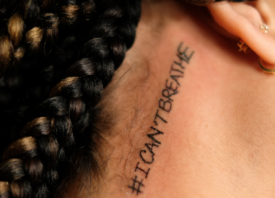
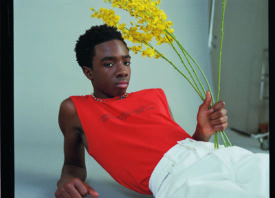
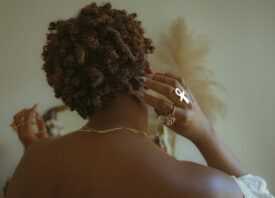
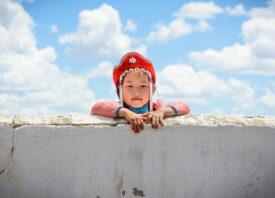
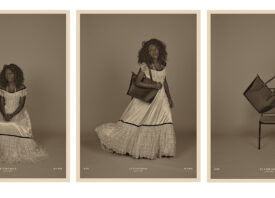
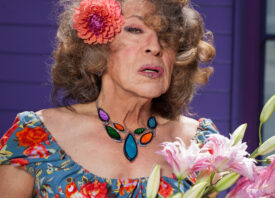
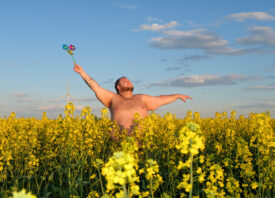
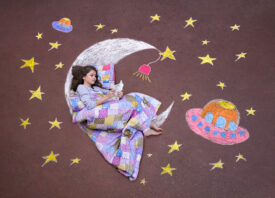
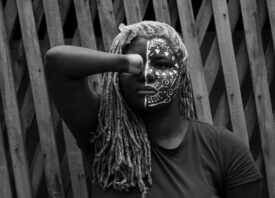
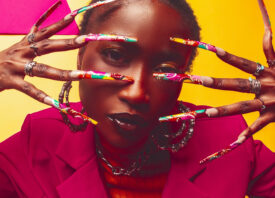
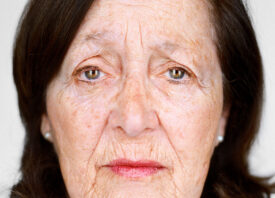
In her tender and strikingly understated series The Mourners, Melbourne-based photographer Georgia Metaxas allows us insight into a world of ritual, culture, memory and loss. In remembrance of those they have lost, the women in these images wear black for the rest of their lives ‘as a sign of perpetual mourning’.
Through the repeating of this ritual, or the continuance of death if you will, the mourners pledge to defy forgetting, de-alienating death and instead turning it into something inevitably linked to the everyday. The portraits poignantly comment on the relationship between memory, photography, and death—one always intertwined with the other.


This post was contributed by photographer Katrin Koenning.

We recently talked to Netherlands-based photographer Lonneke Van Der Palen about his unique style and approach to photography.

What project best represents your photography?
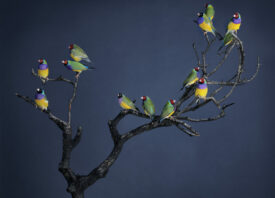
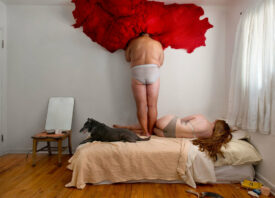
“I’d say that my series Souvenir: memories of a journey never made is the best example. This project was informed by a very personal point of view, and while working on it I didn’t have to conform to anyone else’s opinions. The iconic approach, to both people and objects within the series often poses as an example for me when I work on new projects. You could say that all my work can be linked in one way or another, to Souvenir.”


Your style is really cohesive, how do you manage to keep a personal and recognizable vision also in commissioned works?
“I think that the creative process of an artist is connected to personal tastes and a personal vision. I feel this should always be reflected in one’s work. That way, no matter how different one commissioned series is from another, you will always be able to recognize a certain personal edge to everything one makes.
“In my case this is strongly dependent on certain choices I make. I feel like I have found a way to approach objects that is very much my own. I also have a very particular way of working with colors and light within my projects. That personal edge is what clients are looking for when they enlist me.”

I like that Souvenir feels like I’m looking at a place that isn’t anywhere. Tell me more about the project.
“The series is the result of a staged journey inspired by the ultimate clichés among travel photography. The posing in stunning landscapes, sunsets, wildlife, exotic food, the indigenous population: they almost become icons.
“By recreating these images, photography enables me to visit distant worlds and gather souvenirs of a journey that has never been made. Why buy expensive flight tickets, when I can accomplish the same with my imagination? Using a camera, I don’t have to leave my house to experiences life’s visual marvels.”


This post was contributed by photographer Martina Giammaria.

New York-based photographer Brian Finke has a new long-term project in the works entitled Hip Hop Honeys, a document of the models and culture in hip hop videos. Working with casting directors to obtain access, Finke says he is just getting started with the project, seeing what direction it takes—we think it’s safe to say, so far, so good.


I made eight photographs of different men in my neighborhood. I gave each man a hand-gun and asked him to make an action pose. In our contemporary state of affairs every action is a performance. We are inundated with an endless repetition of imagery. We find ourselves re-watching what we have already seen, whether it be another episode of CSI or the endless 24-hour news cycle of conflict around the globe. We are constantly looking at the same picture: a guy with a gun.
The images of incidents we witness reveal nothing about what is actually happening. There are multiple truths attached to every image we see. Actions are interpreted and each interpretation is different because in the telling and re-telling we don’t reveal the action itself, but rather an assortment of reductions and emphases.—Steven Brahms
Violent Material, a project by New York-based Steven Brahms, explores more than the violent gun culture that exists today, but also how our vernacular imagery is generated and undermined through process and interpretation—a topic that questions the role photography plays in how we understand our world, accurately or not.


This post was contributed by photographer Mark Hartman.


Austrailian-based photographer Graham Miller combines constructed portraits, documentary street portraits, landscapes and still lifes in a series named after the 1992 Leonard Cohen song, Waiting for the Miracle. Miller explores narratives created through the interplay of these images and the connections made between them. While this results in an open ended and ambiguous experience, the images seem to hold compelling stories within the fictional coastal town Miller has constructed. Miller echoes the words of photographer Robert Adams in his statement, speaking of the young protagonists that “cling precariously but tenaciously to a sense of possibility, hope, and resolve.”


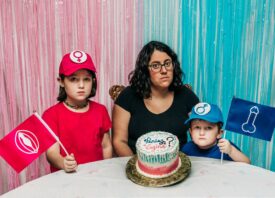
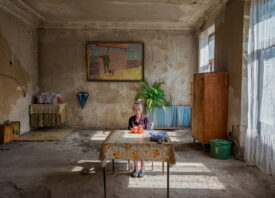
Brooklyn-based photographer Doug Adesko started his series Family Meal to capture an insight into American family life by documenting families eating together. To date, he’s made roughly 75 portraits over the past decade. His interest arose from early childhood memories, and grew as he watched his own daughter at the family table. The portraits seem simple at first glance, but a second, deeper look presents a subtle range of detail—dynamics among family members, hierarchy within the family group, and glimpses into how personality traits affect the behavior of adults and children when together.


Feature Shoot Contributing Editor Carolyn Rauch is the Deputy Director of Photography at Newsweek.


Cinematic, richly saturated images reveal UK-based Hannah Starkey’s deeply personal vision. She chooses seemingly simple scenes—often of a single woman, alone, in a public place, preoccupied with an ordinary task. But she situates the subject in an environment of glass, windows or mirrors that partially obscure the subject while the reflections add dimension and mood to the portrait. Though the photographs at first seem tranquil and contemplative, a second look suggests a deeper, more complex narrative.


Feature Shoot Contributing Editor Carolyn Rauch is the Deputy Director of Photography at Newsweek.

Leah
Being a foreigner in Paris and feeling slightly de-rooted, I tried to get closer to the things and people around me by studying and understanding them. Thus I started to make portraits of Parisian women. I use my work as a means to approach and better undertstand these women, who I first found to be quite different. Having nothing on to cover their bodies, my models seem to envelope themselves in their souls. It is this magic moment I am trying to capture in my lens.—Natasha Gudermane
Mademoiselles is an extensive collection of nudes by Paris-based photographer Natasha Gudermane. A mix of friends and strangers she met on the streets of Paris, Gudermane captured her subjects in their homes amongst their things, making for unique and intimate portraits.

Floriane

Aline

Melanie

Melanie

Leela

Juliette

Jess

Gwen

Gwen

Clementine

Clementine

Charlotte

Celine


This project examines the quickly changing commercial landscape of Ukraine and its impact on the workforce. By moving indoors, into corporate supermarkets and malls, Ukraine is becoming more westernized and homogeneous. The images of street vendors and other small, unlicensed businesses records an element of Ukrainian visual culture as it disappears. Not without irony, the beach portraits capture a black-market economy in the sunshine.—Olena Slyesarenko
Ukrainian photographer Olena Slyesarenko captures a few of her native land’s local vendors—unfortunately a dying breed these days—in her series of portraits, Small Economies: Beach Vendors. A delightful document of various ware and good-toting beachcombers, the work reminds us just what we stand to lose with a move to the corporate world—character, originality, spirit.


This Kind Of Poverty is London-based photographer Spencer Murphy’s series commissioned by Save The Children as part of their UK child poverty campaign in collaboration with Labyrinth Photographic. Shot in 2012, Murphy worked with children over a period of two days in the Poplar Boys And Girls Youth Club in one of the most deprived areas in the UK, Tower Hamlets in east London. He asked them to write down their thoughts about poverty within the UK—’what is it, and how do you feel about it?’ The resulting series combines Murphy’s portraits with the telling words of the children.