Posts tagged as:

fine art photography

David_Burdeny_Photography

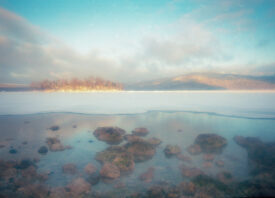
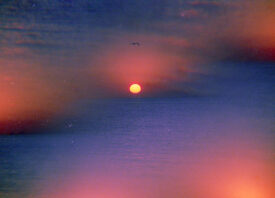
David Burdeny’s graphic Drift series began while he was studying for a degree in architecture in Canada. Inspired by Mark Rothko’s multiform paintings, the series began as a study in landscape and space, using seasonal color and the horizon as the basis of the project. The initial shots were taken near his home in Winnipeg, Canada, but extended across the oceans to England, France and Japan.

The photographs are all of bodies of water, shot with film. The ‘blur’ effect is created directly in-camera using a Roundshot panoramic camera that modified the film internally while the body remained motionless. This technique created a horizontal ‘smearing’ of any stationary objects in the frame, similar to the effect a photo-finish camera has in sporting events. Burdeny found that shooting in areas with strong lighting and heavy contrast produced the best results. The final images are essentially digital prints, but as Burdeny says, although the effect could be created in Photoshop, he prefers to create the blur in-camera, which he believes creates a softer, yet stronger effect.

David_Burdeny_Photography

David_Burdeny_Photography

David_Burdeny_Photography

David_Burdeny_Photography

David_Burdeny_Photography

David_Burdeny_Photography

David_Burdeny_Photography

Feature Shoot Contributing Editor Carolyn Rauch is the Deputy Director of Photography at Newsweek.

Andreas_Gefeller_Photography

Dusseldorf-based photographer Andreas Gefeller created his Japan Series based on an invitation by Japan EU Fest. The organization invites 2-3 European photographers to Japan each year. Gefeller photographed the artfully abstract series of utility poles similar to past work, which explored themes on the relationship between man and nature.

The series consists of two parts—one taken during daylight on cloudy days, another taken in the evenings using only light from passing cars, street lights and house windows. Using long exposures to achieve a desired effect, the lighting illuminates the intricate details of each pole, so that each becomes its own separate, sculptural piece, removed from it’s original background and function. “I see the poles as a metaphor for networks and the flow of data, the proliferating cables represent technologies that are difficult to control,” Gefeller says. “The Japan Series is also about man’s relation to nature; nature turns into man-made technologies that grow without control. The cables remind us of a jungle, beautiful and threatening at the same time.”

Andreas_Gefeller_Photography

Andreas_Gefeller_Photography

Andreas_Gefeller_Photography

Andreas_Gefeller_Photography

Feature Shoot Contributing Editor Carolyn Rauch is the Deputy Director of Photography at Newsweek.

Uday_Kak_Photography

I couldn’t resist featuring owner of New York boutique Maryam Nassir Zadeh,Uday Kak’s luscious photographs of Lucite sculptures. The multi-colored creations are made by New York artist Philip Low. Kak photographs them on simple colored backgrounds to highlight their transparent, jewel-like brilliance. Prints of the sculptures are available at Maryam Nassir Zadeh.

Uday_Kak_Photography

Uday_Kak_Photography

Uday_Kak_Photography

Uday_Kak_Photography

Uday_Kak_Photography

Uday_Kak_Photography

Uday_Kak_Photography

Feature Shoot Contributing Editor Carolyn Rauch is the Deputy Director of Photography at Newsweek.

Zeiss

Scott_Alario_Photography

We are on a search for the spiritually significant, the magic in every day. What will we find that’s worth passing down? What will we conjure?—Scott Alario

Photographer Scott Alario is based in Providence, Rhode Island. His series What We Conjure was made with an 8×10 view camera, and adds to the great lineage of photographers like Emmet Gowin and Nicholas Nixon who have documented those most dear to them. Alario explores his role as a father by making these pictures, occasionally appearing in them himself.

Alario has written a poem that serves as a fitting accompaniment to the images.

I don’t believe that the universe had a beginning, and nor will it have an end.
Both beginnings and ends speak of time, and time is a construct that will fail when our ability to communicate it does.

Energy moves in circles, time’s last moment stands closely to its first.
So how can it be said that we came to be, or came to be wondering about such things as the beginning of it all?

I saw you gain consciousness. It happened.
One day you weren’t, and then you were.
It was something about the sheen in your eyes, lasers:
that day they pierced me.

That’s how it must have been. One day there was just consciousness.
I like to think it was a family, all together at once, urgently, or it could have been a slowly building sense, an awareness growing a mutually shared question, or an endless list of questions.

We will live our lives wondering, and won’t ever know.
In wondering is joy, and wondering together is an ecstatic experience that makes the going in circles part seem worth it.

Scott_Alario_Photography

Scott_Alario_Photography

Scott_Alario_Photography

Scott_Alario_Photography

Scott_Alario_Photography

Scott_Alario_Photography

Scott_Alario_Photography

Scott_Alario_Photography

Scott_Alario_Photography

Scott_Alario_Photography

Feature Shoot Contributing Editor Matthew Leifheit is an independent writer, curator, and photographer based in New York City.

Kyoko_Hamada_Photography

When I first tried on her gray wig, the latex makeup, and her clothes, I gazed at the mirror for a long time. My initial reaction was to chuckle, but I started feeling a little uneasy soon after. The wrinkled face staring back at me resembled my own with thirty-plus years added to it. When I smiled, she smiled back at me. When I pouted, she pouted too.

It was the first time I had met her, but she was simultaneously someone I already knew quite well and someone I knew nothing about. It has been a year and half since I started photographing Kikuchiyo-san and I have gotten used to dressing up as her. However, when I think of what could happen if we ran into each other in a crowded train station or during a walk in the park, I get uneasy imagining her say, “I used to be you.”—Kyoko Hamada

Brooklyn-based photographer Kyoko Hamada steps out of her comfort zone in her latest series I Used to be You. Her work often consists of ordinary people and objects that she stages into quiet moments that explore various metaphors, but this time around Hamada turns the camera on herself to capture Kikuchiyo-san, the future version of herself. The series was born after Hamada spent time volunteering as a visitor to various seniors in NYC. When she discovered that none of the seniors she was working with were interested in being photographed, she decided to experiment on herself. The project turned into an exploration of aging, memory, and the different phases of life.

Kyoko_Hamada_Photography

Kyoko_Hamada_Photography

Kyoko_Hamada_Photography

Kyoko_Hamada_Photography

Kyoko_Hamada_Photography

Kyoko_Hamada_Photography

Kyoko_Hamada_Photography

Kyoko_Hamada_Photography

Kyoko_Hamada_Photography

Kyoko_Hamada_Photography

Kyoko_Hamada_Photography

Feature Shoot Contributing Editor Julia Sabot is the Associate Photo Editor at Dwell.

Brian_Finke_Photography

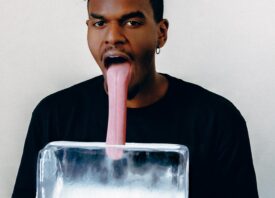
New York-based photographer Brian Finke has a new long-term project in the works entitled Hip Hop Honeys, a document of the models and culture in hip hop videos. Working with casting directors to obtain access, Finke says he is just getting started with the project, seeing what direction it takes—we think it’s safe to say, so far, so good.

Brian_Finke_Photography

Brian_Finke_Photography

Brian_Finke_Photography

Brian_Finke_Photography

Brian_Finke_Photography

Brian_Finke_Photography

Brian_Finke_Photography

Brian_Finke_Photography

Brian_Finke_Photography

Siri_Kaur_Photography

I’m going back to basics, back to the sheer joy of playing with color and line on paper, of drawing with light. This project re-engages with one of the simplest and most basic purposes of photography: to show us what would otherwise remain unseen. I’m using science and technology to show my particular romantic view of the medium of photography, where the failure and power of the medium cohere in material form.—Siri Kaur

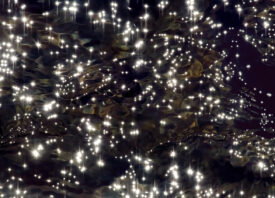
Half of the Whole is a project that LA-based photographer Siri Kaur calls a photographic exploration of time and light. She started the project in 2007, traveling to Kitt Peak in Arizona to photograph outer space. With the help of planetary scientists, she captured pictures of distant galaxies on a digital sensor attached to a Meade solar telescope.

Post-shoot she works the techniques of traditional color darkroom printing—a subtractive color system—using cyan, magenta, and yellow filters to remove various colors of light from the negatives, eventually making contact prints that reveal the negative’s colors in reverse. The resulting images are microcosms of light and matter, each one unique from the next. Kaur calls them “experiments”, and we’re glad she’s conducting them.

Siri_Kaur_Photography

Siri_Kaur_Photography

Siri_Kaur_Photography

Siri_Kaur_Photography

Siri_Kaur_Photography

Siri_Kaur_Photography

Siri_Kaur_Photography

Siri_Kaur_Photography

Siri_Kaur_Photography

Nicholas-Alan-Cope_Photography

Los Angeles-based photographer Nicholas Alan Cope shoots architectural subjects as abstract still lifes. For the buildings he shot in Los Angeles (made into a book called Whitewash, published by PowerHouse Books), he strips all detail from the structures, leaving portraits consisting only of lines, planes and shapes. The intense, black-and-white images provide a fresh and simplified view of everyday structures in a sprawling, complex metropolitan city.

cope

Nicholas-Alan-Cope_Photography

Nicholas-Alan-Cope_Photography

cope

Feature Shoot Contributing Editor Carolyn Rauch is the Deputy Director of Photography at Newsweek.

Luigi_Bonaventura_Photography

Behind the Edge showcases hotel facades in Jesolo Beach, Venice. Shot by Italian born, New York-based photographer Luigi Bonaventura, his intention is to show each structure as its Platonic ideal—as the architect imagined it. The repetitive forms and pops of color combine to create a graphic, eye-pleasing series.

Luigi_Bonaventura_Photography

Luigi_Bonaventura_Photography

Luigi_Bonaventura_Photography

Luigi_Bonaventura_Photography

Luigi_Bonaventura_Photography

Luigi_Bonaventura_Photography

Luigi_Bonaventura_Photography

Malka_Oppermann_Photography

Throughout the trip, the only consistent form of structure was the company of one another. Time became elastic and weeks departed from what our knowledge of what a “week” meant. As a result, we have collected an array of photographs which emote our sense of constant displacement yet express a deep love of travel and discovery.—Yael Malka and Cait Oppermann

After their recent graduation from Pratt Institute, Brooklyn-based photographers Yael Malka and Cait Oppermann backpacked for 70 days through Turkey, Morocco and several countries in Europe. The photos they took during that time are now collected in their self-published book Sea Blues.

Filled with idiosyncratic extractions from the artists’ journey as well as portraits of one another, Sea Blues is a collaboration between friends. These are notes from the road, a traveler’s handbook that allows the viewer to share in the amazing freedom of summery vagabonding in strange lands.

A book launch will take place at Molasses Books in Brooklyn on May 17, 2013.

cait

Yael

Malka_Oppermann_Photography

Malka_Oppermann_Photography

Malka_Oppermann_Photography

Malka_Oppermann_Photography

Feature Shoot Contributing Editor Matthew Leifheit is an independent writer, curator, and photographer based in New York City.