David_Burdeny_Photography

David Burdeny’s graphic Drift series began while he was studying for a degree in architecture in Canada. Inspired by Mark Rothko’s multiform paintings, the series began as a study in landscape and space, using seasonal color and the horizon as the basis of the project. The initial shots were taken near his home in Winnipeg, Canada, but extended across the oceans to England, France and Japan.

The photographs are all of bodies of water, shot with film. The ‘blur’ effect is created directly in-camera using a Roundshot panoramic camera that modified the film internally while the body remained motionless. This technique created a horizontal ‘smearing’ of any stationary objects in the frame, similar to the effect a photo-finish camera has in sporting events. Burdeny found that shooting in areas with strong lighting and heavy contrast produced the best results. The final images are essentially digital prints, but as Burdeny says, although the effect could be created in Photoshop, he prefers to create the blur in-camera, which he believes creates a softer, yet stronger effect.

David_Burdeny_Photography

David_Burdeny_Photography

David_Burdeny_Photography

David_Burdeny_Photography

David_Burdeny_Photography

David_Burdeny_Photography

David_Burdeny_Photography

Feature Shoot Contributing Editor Carolyn Rauch is the Deputy Director of Photography at Newsweek.

Andreas_Gefeller_Photography

Dusseldorf-based photographer Andreas Gefeller created his Japan Series based on an invitation by Japan EU Fest. The organization invites 2-3 European photographers to Japan each year. Gefeller photographed the artfully abstract series of utility poles similar to past work, which explored themes on the relationship between man and nature.

The series consists of two parts—one taken during daylight on cloudy days, another taken in the evenings using only light from passing cars, street lights and house windows. Using long exposures to achieve a desired effect, the lighting illuminates the intricate details of each pole, so that each becomes its own separate, sculptural piece, removed from it’s original background and function. “I see the poles as a metaphor for networks and the flow of data, the proliferating cables represent technologies that are difficult to control,” Gefeller says. “The Japan Series is also about man’s relation to nature; nature turns into man-made technologies that grow without control. The cables remind us of a jungle, beautiful and threatening at the same time.”

Andreas_Gefeller_Photography

Andreas_Gefeller_Photography

Andreas_Gefeller_Photography

Andreas_Gefeller_Photography

Feature Shoot Contributing Editor Carolyn Rauch is the Deputy Director of Photography at Newsweek.

Uday_Kak_Photography

I couldn’t resist featuring owner of New York boutique Maryam Nassir Zadeh,Uday Kak’s luscious photographs of Lucite sculptures. The multi-colored creations are made by New York artist Philip Low. Kak photographs them on simple colored backgrounds to highlight their transparent, jewel-like brilliance. Prints of the sculptures are available at Maryam Nassir Zadeh.

Uday_Kak_Photography

Uday_Kak_Photography

Uday_Kak_Photography

Uday_Kak_Photography

Uday_Kak_Photography

Uday_Kak_Photography

Uday_Kak_Photography

Feature Shoot Contributing Editor Carolyn Rauch is the Deputy Director of Photography at Newsweek.

Zeiss

Scott_Alario_Photography

We are on a search for the spiritually significant, the magic in every day. What will we find that’s worth passing down? What will we conjure?—Scott Alario

Photographer Scott Alario is based in Providence, Rhode Island. His series What We Conjure was made with an 8×10 view camera, and adds to the great lineage of photographers like Emmet Gowin and Nicholas Nixon who have documented those most dear to them. Alario explores his role as a father by making these pictures, occasionally appearing in them himself.

Alario has written a poem that serves as a fitting accompaniment to the images.

I don’t believe that the universe had a beginning, and nor will it have an end.
Both beginnings and ends speak of time, and time is a construct that will fail when our ability to communicate it does.

Energy moves in circles, time’s last moment stands closely to its first.
So how can it be said that we came to be, or came to be wondering about such things as the beginning of it all?

I saw you gain consciousness. It happened.
One day you weren’t, and then you were.
It was something about the sheen in your eyes, lasers:
that day they pierced me.

That’s how it must have been. One day there was just consciousness.
I like to think it was a family, all together at once, urgently, or it could have been a slowly building sense, an awareness growing a mutually shared question, or an endless list of questions.

We will live our lives wondering, and won’t ever know.
In wondering is joy, and wondering together is an ecstatic experience that makes the going in circles part seem worth it.

Scott_Alario_Photography

Scott_Alario_Photography

Scott_Alario_Photography

Scott_Alario_Photography

Scott_Alario_Photography

Scott_Alario_Photography

Scott_Alario_Photography

Scott_Alario_Photography

Scott_Alario_Photography

Scott_Alario_Photography

Feature Shoot Contributing Editor Matthew Leifheit is an independent writer, curator, and photographer based in New York City.

Doug_Ischar_Photography

Marginal Waters, shot by American photographer Doug Ischar in 1985, documents one of the most visible urban gay beaches in North America—on the Belmont Rocks in the city of Chicago—during the height of the AIDS crisis. The images are multi-layered, they “depict a seemingly edenic world of toned, sun-bathed bodies, behind which lurk the spectres of AIDS and reaction.”

Undertow, a three part exhibition featuring Ischar’s Marginal Waters, his installation work of the 1990s, and his recent experimental films, is currently on view at Gallery 44 in Toronto, as part of the Scotiabank CONTACT Photography Festival. It runs through June 15, 2013.

Doug_Ischar_Photography

Doug_Ischar_Photography

Doug_Ischar_Photography

Doug_Ischar_Photography

Doug_Ischar_Photography

Doug_Ischar_Photography

Doug_Ischar_Photography

Doug_Ischar_Photography

Doug_Ischar_Photography

Doug_Ischar_Photography

Doug_Ischar_Photography

Doug_Ischar_Photography

Doug_Ischar_Photography

Doug_Ischar_Photography

Doug_Ischar_Photography

elizabeth_renstrom_Photography

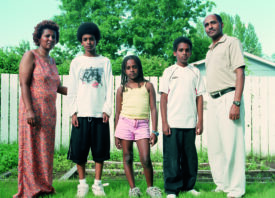
I wanted to investigate the icons we associate with girls to discuss why we assign these symbols in the first place. I wanted to place familiar things like horses, dolphins, and the color-soaked creations of Lisa Frank into the small bouts of real estate girls can make their own growing up. That’s why there’s a lot of locker school supply action going on—it’s thinking about the tools we’ve been given to express ourselves and how they look in different environments.—Elizabeth Renstrom

While she wouldn’t call them autobiographical, Brooklyn-based Elizabeth Renstrom’s photographs in Lisa Frank Blues are a captivating testament to her experiences as a preadolescent girl in the 1990s and early Y2ks. Renstrom’s tableaux of sticker-adorned cell phones and all things pastel are a glimpse into the complex machine of girly, pre-teen pop culture. Press-on nails, JTT, and Lisa Frank pencils gave girls in the 90s a way to relate to one another—a medley of sentimentality and cult-value.

elizabeth_renstrom_Photography

elizabeth_renstrom_Photography

elizabeth_renstrom_Photography

lisa-frank

elizabeth_renstrom_Photography

This post was contributed by photographer Lisa Gonzalez.

Kyoko_Hamada_Photography

When I first tried on her gray wig, the latex makeup, and her clothes, I gazed at the mirror for a long time. My initial reaction was to chuckle, but I started feeling a little uneasy soon after. The wrinkled face staring back at me resembled my own with thirty-plus years added to it. When I smiled, she smiled back at me. When I pouted, she pouted too.

It was the first time I had met her, but she was simultaneously someone I already knew quite well and someone I knew nothing about. It has been a year and half since I started photographing Kikuchiyo-san and I have gotten used to dressing up as her. However, when I think of what could happen if we ran into each other in a crowded train station or during a walk in the park, I get uneasy imagining her say, “I used to be you.”—Kyoko Hamada

Brooklyn-based photographer Kyoko Hamada steps out of her comfort zone in her latest series I Used to be You. Her work often consists of ordinary people and objects that she stages into quiet moments that explore various metaphors, but this time around Hamada turns the camera on herself to capture Kikuchiyo-san, the future version of herself. The series was born after Hamada spent time volunteering as a visitor to various seniors in NYC. When she discovered that none of the seniors she was working with were interested in being photographed, she decided to experiment on herself. The project turned into an exploration of aging, memory, and the different phases of life.

Kyoko_Hamada_Photography

Kyoko_Hamada_Photography

Kyoko_Hamada_Photography

Kyoko_Hamada_Photography

Kyoko_Hamada_Photography

Kyoko_Hamada_Photography

Kyoko_Hamada_Photography

Kyoko_Hamada_Photography

Kyoko_Hamada_Photography

Kyoko_Hamada_Photography

Kyoko_Hamada_Photography

Feature Shoot Contributing Editor Julia Sabot is the Associate Photo Editor at Dwell.

persol-reflex-2

Eyewear brand Persol have just added to their impressive selection with the ‘Reflex Edition’, the latest collection of three glasses inspired by classic vintage cameras. To celebrate, the brand have launched the Reflex Edition Photo Contest, giving you the chance to win a trip for 2 to Venice and a brand new Leica M-E.

Submit your Black & White themed photographs to enter.

*Sponsored

Brian_Finke_Photography

New York-based photographer Brian Finke has a new long-term project in the works entitled Hip Hop Honeys, a document of the models and culture in hip hop videos. Working with casting directors to obtain access, Finke says he is just getting started with the project, seeing what direction it takes—we think it’s safe to say, so far, so good.

Brian_Finke_Photography

Brian_Finke_Photography

Brian_Finke_Photography

Brian_Finke_Photography

Brian_Finke_Photography

Brian_Finke_Photography

Brian_Finke_Photography

Brian_Finke_Photography

Brian_Finke_Photography

Ryann_Ford_Photography
Near Big Bend National Park, Texas

All over the country, rest areas are losing the fight to commercial alternatives: drive-thrus at every exit and mega-sized travel centers offering car washes, wi-fi, grilled paninis and bladder-busting sized fountain drinks. Louisiana has closed 24 of its 34 stops, Virginia, 18 of its 42; pretty much every state in the country has reduced its number of rest areas, or at least cut operating hours. And they’re not just being closed, they’re being demolished.

For the past 53 years, rest stops have given us rest, relief, hospitality and nostalgia. They have been an oasis of green to walk your dog, have a picnic, study the map. We can all relate to rest stops and what they represent as social and architectural icons of Americana. To me though, they are disappearing waysides of memories, anticipation and mystery of what the next one down the road will look like.—Ryann Ford

Austin-based photographer Ryann Ford honors the charm of roadside rest stops throughout the U.S. in her series Rest Stops: Vanishing Relics of the American Roadside. Inspired to systematically document them before they disappear, Ford creates a typological highlight of their architecture, environment, and spirit.

Ryann_Ford_Photography
White Sands National Monument, New Mexico

Ryann_Ford_Photography
Near Burleson, Texas – I-35

Ryann_Ford_Photography
Galveston, Texas

Ryann_Ford_Photography
Walker Lake, Nevada – U.S. 95

Ryann_Ford_Photography
Near Thackerville, Oklahoma – I-35

Ryann_Ford_Photography
Monument Valley, Arizona

Ryann_Ford_Photography
Petrified Forest National Park, Arizona

Ryann_Ford_Photography
Near Abiquiu, New Mexico – U.S. 84

Ryann_Ford_Photography
Juan Santa Cruz Picnic Area – Tucson, Arizona

Ryann_Ford_Photography
Near Augustus, Texas – U.S. 84

Ryann_Ford_Photography
Saguaro National Park, Arizona

Ryann_Ford_Photography
Anthony, New Mexico – I-10 – New Mexico/Texas Border

If you’re a photographer, you can now promote your new series, website, gallery show, recent assignment, etc. on Feature Shoot for an affordable price. Find out about becoming a Spotlight Photographer here.