Posts by author:

Laura Barisonzi

Melissa_Cacciola_Photography

Melissa_Cacciola_Photography

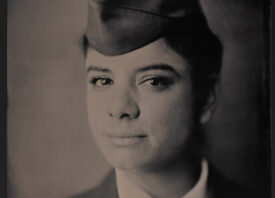
New York based photographer Melissa Cacciola recently talked to us about War and Peace, a series of tintype portraits of active duty military and veterans. The work is currently on display at United Photo Industries in Brooklyn through April 27th, 2013.

How did you select the active duty military and veterans that you shot for this series?
“I began by calling, writing, and e-mailing five government branches, my local congressman, and by visiting recruiting offices. Without having connections or contacts, finding willing subjects could have been an impossible process. It really wasn’t until I made contact with two Marines that things began to move forward.

“The United States Coast Guard, Navy, Army, and the Wounded Warrior Project gave me their full support so that I could get access to the people I needed. So many people trusted me without knowing me or about my work. I could not have told their story otherwise.”

Melissa_Cacciola_Photography

Melissa_Cacciola_Photography

Was there a specific reason that you chose to document the military using tintype?
“I began War and Peace during the anniversary year of September 11th as a way of reflecting on how this event impacted the nation and New York City. We have been a country at war in Iraq and Afghanistan for over twelve years now and many of the people I photographed for my project enlisted because of 9/11. We often talk about warfare in technological terms, but there is a human side to it. I wanted to create intimate portraits. And considering the origin of tintyping, it was also a unique opportunity to explore the rich history of the tintype and its beginnings documenting the Civil War.”

Melissa_Cacciola_Photography

Melissa_Cacciola_Photography

What was the conversation with the subjects like regarding the non-military version of their portraits? Did they choose what they would wear themselves?
“I asked my subjects to make their civilian portrait as personal as possible in an effort to connect with the viewer. Each person put a great deal of thought into his/her portrait. Ray, a U.S. Coast Guard officer, wore a guayabera in honor of his Puerto Rican heritage while Edward wore a business suit to symbolize his re-entry into the non-military sector of commerce from the U.S. Marine Corps.

“Each little detail you see in the civilian portraits carries a great deal of weight and meaning. Much like Roland Barthes’ punctum, there are layers to explore within a single gesture. In contrast, the military portraits had to be so structured because of rules governing how uniforms could be worn, from the angle of a cover or hat to the polish of buttons on the jackets.”

Melissa_Cacciola_Photography

Melissa_Cacciola_Photography

Your bio says that you studied historic preservation of fine art, how do you think that created and influenced your perspective as a photographer?
“Having a background in fine art means that I’m always looking at art—whether it be Velasquez’s paintings of the Spanish court, Bill Viola’s transformative video installations, or the photographs of August Sander. Often at a microscopic level, I’m investigating brushstrokes in a painting or the gelatin reticulation pattern in a print. Tintyping brings together my interests in history, process, and chemistry.”

Melissa_Cacciola_Photography

Melissa_Cacciola_Photography

How did you first start working in tintype? You studied some tintype techniques with John Coffer but what first interested you in the process?
“I fell in love with tintyping during a class in historic preservation at the Metropolitan Museum of Art. We were studying tintype portraits from the Civil War. They were so powerful and haunting I couldn’t stop thinking about them. That was what brought me to study with John Coffer and embark on my own with the technique.”

Since the original idea of the tintype was to show the subject their image right away, was this something you did with your subjects?
“Absolutely. Everyone that comes to the studio for a portrait ends up in the darkroom seeing his/her portrait materialize in the fixer. It’s pure magic every time. I never get tired of or take this very intimate and special moment for granted.”

This post was contributed by photographer Laura Barisonzi.

Nathan_Wirth_photography

Nathan Wirth is a San Francisoco-based fine art photographer. Many of his images of stark landscapes in and around the San Francisco Bay area were taken with an Infrared-modified DSLR, yielding stunning results. Wirth’s landscapes are serene, inviting, thoughtful. He recently talked to us about process and technique.

Do you shoot film infrared or do you shoot with a modified for infrared digital camera?
“My first experiments with infrared were with a Sony Alpha 700 DSLR and Hoya’s R72 infrared filter. The filter is very dark and even on a bright day with a fairly wide aperture it takes at the very least, several seconds. I really liked playing with long exposure infrared shots, but with my available lenses, the exposures of a second or more often produced a very annoying hot spot in the center of the image that was quite difficult to work around, so I eventually modified my first DSLR, a Sony Alpha 100, so I could easily take handheld shots and not have to deal with those annoying hot spots.”

Nathan_Wirth_photography

How do you previsualize what the infrared pictures will look like before you take them?
“When I had my camera modified by lifepixel, I chose their Deep BW IR filter (equivalent to an 830nm filter), which in general produces very stark contrasts between the blacks and the whites. The typical “look” of most infrared images highlights and exaggerates the snowy white vegetation, giving it a glow, so much so that for my tastes, it becomes far more about the gimmick than the composition, the mood, or the tone, which are the things that I am most concerned with. I strive to find the warmest, strongest tonal qualities possible, so I tend to downplay that eggshell white so often associated with IR images.

“I previsualize what I want by anticipating what those contrasts will likely be—and the rest of the vision and processing comes down to working with a composition that does not rely on the gimmick. I don’t want a “fantasy world” image. I want to create something that has warm, engaging tones, something with a sprinkle or two of yellow to bring out the warmth of those tones. In other words, I want to use the infrared to complement the mood, not define it.”

Nathan_Wirth_photography

Nathan_Wirth_photography

You have mentioned that you like shooting without thinking too much, without expectation and analysis. How does this type of technique work with long exposures? Is there a lot of trial and error in your process?
“The true allure for me in both long exposure and infrared photography is the element of surprise. No matter how good I have gotten at anticipating what I will get, I still from time to time end up with these remarkable nuances of light and shadow that I had not anticipated. That said, with practice I have gotten to the point where I can more or less guess what I will get and what weather conditions and quality of light will yield which tones and how long an exposure needs to be to get a desired effect.

“Initially, I had to go through a lot of trial and error, but now these matters are part of my toolbox. I don’t wander around for long periods of time trying to measure and calculate the best composition. Instead, I usually just see it and go from there. I let the mood, light, and moment dictate where I will go and what I will do. I typically photograph by myself, and that quality of solitude plays an important role in what I am trying to express and how I go about doing it.”

Nathan_Wirth_photography

What time of day and weather conditions do you prefer to shoot this work in?
“In general, I prefer cloudy days. My favorite conditions are usually found in-between rain storms, when those dark clouds are moving and the sunlight is bursting through the various openings that come and go with the movement. I especially love those days when the clouds are dark, but the sun is out and illuminating the sea, the rocks, the bridge, the building or other features of a cityscape, landscape, or seascape. I prefer the light found during sunrise and sunset, both for my infrared and my long exposures. There is an undeniable warmth to that light that transfers well to both monochrome long exposures and infrared shots.”

Nathan_Wirth_photography

You mention that a lot of your work is done in an improvisational way. Can you expand on that?
“When I speak of improvisation, I am thinking about a state in which I let my mind go while I process and just work my way through the image as it seems fit, and if even possible, to remove my ego and expectations and worries about how an image will be potentially received. It is very easy to get in one’s own way when processing an image—or even when choosing what to photograph. Second guessing can be stifling and relying on a set group of presets or tried and true processing maneuvers can be limiting.

“I also find tones and contrasts without approaching the image from a preconceived notion of what a seascape, landscape, architectural shot ’should look like’ and, instead, I am willing to discover the image by simply exploring the possibilities. I am not, however, saying that I just float around willy-nilly or aimlessly and wait to see if something happens. I just don’t overthink what I am doing. I simply just do it by letting the process unravel in the moment.”

Nathan_Wirth_photography

This post was contributed by photographer Laura Barisonzi.

Marcel-Christ

Marcel Christ is an advertising and fine art photographer specializing in still life. He is based in his native Amsterdam but frequently works in Paris, London, and New York. Before becoming a photographer he studied to be a chemical engineer. It is perhaps this study which influences his intense attention to and observation of materials.

His personal project Clouds is a study of the patterns which develop as paint disperses in water. Many of his other works capture the movement of materials such as powder and ink which are similar to paint in their unpredictability and creation of new shapes and structures.

Marcel-Christ

Marcel-Christ

Marcel-Christ

Marcel-Christ

Marcel-Christ

This post was contributed by photographer Laura Barisonzi.

George-Steinmetz Sandstone Pinnacles, Karnasai Valley, Chad, 1998George Steinmetz, Sandstone Pinnacles, Karnasai Valley, Chad, 1998. Courtesy Anastasia Photo

American photographer George Steinmetz is best known for his exploration photography. Since 1986, he has completed 31 major photo essays for National Geographic and 25 stories for GEO magazine in Germany. This year he celebrates the release of his third book, Desert Air, a photographic journey 15 years in the making in which he captures the world’s remote and extreme deserts from the seat of his motorized paraglider.

A book signing with Steinmetz will be held on Thursday, December 13, 6:00–7:30pm at the International Center for Photography Store in New York. Desert Air is currently on display at Anastasia Photo in New York through March 3, 2013.

George-Steinmetz Salt Works, Teguiddia-n-Tessoumt, NigerGeorge Steinmetz, Salt Works, Teguiddia-n-Tessoumt, Niger, 1997. Courtesy Anastasia Photo

What can you detail about your process of choosing locations; how much are you able to predict what will be visually striking before you are up in the air above it?
“It’s changed over the years. I use Google Earth a lot as a resource. It has limitations but for general scouting it’s really quite wonderful. I recently did a shoot on the Jersey shore looking for hurricane damage. Although Google Earth wasn’t up to date enough to see the damage it was good for figuring out areas I might want to go to that might have good patterns.

“Also, as I’ve been doing this for a long time, maps can be very good. Before Google Earth I relied on maps, especially detailed maps that show terrain. For example, the French have the IGN (Institut Géographique National) which is really detailed and shows dune patterns and different kinds of geography. I also rely a lot on the maps from the USGS (U.S. Geological Survey).”

George-Steinmetz1 Expedition Cars Crossing the Salar de Uyuni, BoliviaGeorge Steinmetz, Expedition Cars Crossing the Salar de Uyuni, Bolivia 2007. Courtesy Anastasia Photo

What do you look for on Google Earth or on the maps that helps you to know there will be good photos there?
“I look for patterns in the terrain. In the old days I had a friend in NASA and I learned to see things in the non-visible wavelengths, which are very subtle; far beyond what Google Earth could show which is only the visible spectrum. Google Earth can be very monochromatic; a lot of it depends on the time of year and time of day that the image was captured. For example, I was looking at images of China on Google Earth that had been taken in the winter. The lakes were frozen and you couldn’t really see that they were lakes.

“However, there’s nothing quite like looking around on the ground, and I frequently discover things I didn’t know were there that way. I like to shoot at harvest time – there will be wonderful patterns out in the ground. A war photographer friend of mine once told me that you get the best pictures by not being in the middle of the conflict but by being on the edge of it. From above oceans aren’t that interesting and rivers are really boring, but on the edges you find really cool stuff.”

George-Steinmetz Pacific Coast, Southern PeruGeorge Steinmetz, Pacific Coast, Southern Peru, 1999. Courtesy Anastasia Photo

George-Steinmetz Camel Caravan, Mauritania,George Steinmetz, Camel Caravan, Mauritania, 1997. Courtesy Anastasia Photo

What do you think it is about arid landscapes that has particularly attracted you? Are they better suited for aerial photography?
“Yes they are, for a lot of reasons. One of them is that you can see the earth with its living skin peeled away. Also deserts are one of the great classes of wilderness left on the planet; I find them to be really fascinating. Most of the temperate lands have been manipulated by humans and you don’t see their natural state anymore. If I could spin my paraglider over North America 500 years ago it would be incredible, but now it’s been turned into subdivisions and parking lots. The desert still has huge tracts of land with natural patterns intact.”

George-Steinmetz Beni Isguen, Algeria, 2009George Steinmetz, Beni Isguen, Algeria, 2009. Courtesy Anastasia Photo

Have you done much shooting with your glider in Antarctica or the Arctic?
“No, it’s very cold and windy. The winds come up very quickly and blow you out to sea, which is a bad combination. The glider is ideal in warm weather, but in the cold with no fuselage you are swinging like a lawn chair on a string and it gets tough on your hands. Your hands take a beating holding something made of metal when it’s below freezing.”

George-Steinmetz Evaporation Ponds, Dead Sea, Israel 2008George Steinmetz, Evaporation Ponds, Dead Sea, Israel 2008. Courtesy Anastasia Photo

Is there a specific height off the ground that you find is your sweet spot or get the best results shooting from? You seem to avoid the more abstract angle of shooting straight down that seems to be common in a lot of aerial photography. Is that on purpose?
“I like taking pictures of things that no one has ever seen before. That’s really what photography is all about, seeing things in a new way. From 50 feet up, it’s telephone pole height – not so interesting. I really like shooting from somewhere between 100-300 feet.

“There I can see the world in a more 3-dimensional way; you can make people out and see what they’re doing, you can see what ethnic group they are, you can see if its a donkey or a camel. When you get up too high you lose a lot of color; things get blue or greyed out. Most aerial photos are taken in a plane 500-1000 feet up, and the result is visually very flat. What I’m doing is more personal.”

George-Steinmetz Paraglider over Mega Dunes, Dasht-e Lut, Iran 2003George Steinmetz, Paraglider over Mega Dunes, Dasht-e Lut, Iran 2003. Courtesy Anastasia Photo

Have you explored other methods of aerial photography such as helicopters, light planes or balloons? If so, what do you like most about your particular method of motorized paraglider?
“I have done them all; hot air balloon, fixed wing, Cessnas, and all kinds of helicopters. I’ve used big monstrous Russian helicopters with 30 passenger transports. 10 seaters, 5 seaters, 2 seaters etc. Helicopters are great, but the glider has advantages. It’s much quieter and has no downwash, which is important over sensitive terrain to avoid the downwind that creates patterns on the earth.

“Also, with the helicopter you’re going to get people angry on the ground. They’re obnoxious and loud, you feel like you’re under attack in a Vietnam movie when someone is flying low above you. With the paraglider, generally people look at it and say ‘who is that crazy guy, that looks like a lot of fun and kind of dangerous’. It’s a different vibe, friendlier, more personal.”

George-Steinmetz  Sun Bathers, Dead Sea, Israel 2008George Steinmetz, Sun Bathers, Dead Sea, Israel 2008. Courtesy Anastasia Photo

Is there a certain focal length that you favor in this shooting or do you zoom in and out a lot depending on the scene below you?
“From a visual standpoint, you are able to move directly towards your subject and as you move toward it you see the spatial relationships change between the foreground and the background and you get that whole range of perspective. Typically in helicopters you just get a couple of frames from a particular angle, most pilots will circle around the thing you are photographing. The helicopter pilots don’t really like to hover. Hovering in a helicopter requires drawing a lot of power and it gets bumpy and bouncy.”

“In a glider you have a full range of vision in front of you whereas in helicopters you shoot off the side. Sometimes in order to render the shot the way I want, I have to shoot from a very specific point. At times you need to be within a few feet of something; in my glider I’ll go around and around and around trying to get that perspective right. If I can just get one great picture a day I’m happy. I’ll just play with it over and over and if I’m in my glider there’s no one to complain.”

George-Steinmetz Barchan Dunes, Paracas National Park, Peru, 1999George Steinmetz, Barchan Dunes, Paracas National Park, Peru, 1999. Courtesy Anastasia Photo

How do you manage to fly the glider and photograph at the same time? Do you ever crash?
“It takes some concentration and chutzpah. The big advantage is that I’m the pilot, I can put myself exactly where I want in the sky. I don’t have to communicate with someone else where I want to go, it’s instinctual. Having to pilot it at the same time can be a little awkward, but once the aircraft is on the same course it’s self-correcting and self-stabilizing.

“I’ve had some bad wrecks. I had a bad crash in China and I got 17 stitches. I had a crash in Ethiopia where my fingers never quite went straight again. I had a crash in Mexico and I landed in the water, everything was destroyed except me. But in general it’s kind of like falling off a bike, it’s not that bad. The plane is so light, the motor weighs less than 100 pounds, and when you crash the parachute is still up so it takes on some of the weight of the fall. I wear a helmet and kneepads. It’s like being a football player when you get tackled – it’s undignified, hurts, and should be avoided, but it’s survivable.”

Adjder Oasis, Algeria, 2009 George-Steinmetz8George Steinmetz, Adjder Oasis, Algeria, 2009. Courtesy Anastasia Photo

This post was contributed by photographer Laura Barisonzi.

Lottie Davies

Lottie Davies is a UK-born photographer who is based in London. Her series North features images from Iceland, Finland, Greenland, Svalbard (Spitzbergen), an Arctic archipelago that belongs to Norway, and the UK.

Lottie Davies

What can you tell us about your process of choosing locations? Were you on assignment or were they personal trips?
“It’s a mixture; mostly commissioned trips but some personal. Certainly quite a few were with Lonely Planet. Greenland was my first job with them and it was great. Remote, cold, a bit weird, just the way I like my travel! I’m attracted to the ‘far away’, anywhere where cellphones don’t work and you may need to sleep in a tent. It’s not that I enjoy being uncomfortable, it’s more that places which are hard to get to are less changed by humans, and I can imagine those landscapes being the same now as they were thousands of years ago. I like that.”

Lottie Davies

One striking thing about this series is how colorful the photos are when many photos of the Arctic are washed out grays or blues. Was this because of a certain time of year, time of day, and/or specific subject matter that you prefer to shoot?
“My visits so far have not been in winter, generally because it gets very dark later in the year and practical considerations make the warmer seasons a more sensible option. So, given I’m not there in snow season and if I’m lucky I get a clear blue sky, the sun can be gloriously bright, and the air and water are very clean and clear – hence more saturated colors. I like to use a polarizing filter to cut through the distance haze and bring the sky in.

“In Iceland there are volcanoes that spit out lava beds and peculiar colored mountains of rhyolite and other minerals. In some areas like Landmannalugar there grows a brilliant, bright green moss that makes the whole place look like an alien world; it’s fabulously beautiful.

“In terms of colors and subject matter, generally there isn’t much time on a travel assignment; there’s often a distance to cover and many things to shoot in a short time, so I try to pack everything in. I often get up before dawn to make sure that I have at least one shot of a landscape before the day’s weather comes in. If it rains the rest of the day, at least at dawn you always have a lovely soft cold light which I love. If it’s sunny later, then you’ve got two options, but often by then you’ve had to move onto a new place. I always think ’shoot it now, you don’t know if you’ll have another chance’.”

Lottie Davies

The above shot is stunning, where was it taken?
“It’s in Svalbard, in the Arctic Circle. I was on another ship traveling from Longyearben to Pyramiden, a recently abandoned Russian mining town which boasts the northernmost bust of Lenin in the world, at 79 degrees north. The water is incredibly clean and the wind was bitterly cold. We were served gin and tonic with glacier ice pulled up from the water about 10 minutes after I shot this. In Svalbard there is very little vegetation as it is so far north, so the striations you see in the mountains are in fact ancient seabed silt deposits which have become rock and been pushed up above the water by the movements of tectonic plates.”

Lottie Davies

Lottie Davies

What are the challenges that you have experienced shooting in locations with cold temperatures or limited light during the day? What are some of the methods you’ve used shooting in locations such as this?
“Cold temperatures are fine providing I have the right clothes. It’s taken me a while to work out my perfect kit, but lots of layers, thermals, and really thick socks are central to comfort. If I were to travel in winter I would have to watch out for frostbite and such, but I’ve yet to face those temperatures. Generally though, I’m more comfortable in colder climates, I don’t deal with heat and humidity terribly well (I’m a Welsh/Scots redhead so you can imagine I’m pale and burn in ten minutes).

“Camera-wise, I try to keep spare batteries warm, and lots of them, and have enough card-space to shoot all day without having to download. I like to keep the laptop and hard drives somewhere stable and safe during the day and download when it’s too dark to shoot. I shoot my personal work on film, which handles the cold much more easily than digital systems.

“My shoot in Finland was exclusively on 5×4 at -20 degrees and snow. For that trip, as I knew I would be shooting long exposures in cold temperatures, I took a Wista field camera made with brass and rosewood, which doesn’t freeze. My breath was making pretty frost patterns on the backplate which made it a little unusual for focusing, but apart from that it worked perfectly. No batteries, no electronics, just a box, a lens and a cable release; lovely. And I had my snow boots and Arctic parka – toasty warm all day.”

Lottie Davies

How much do you plan your itinerary and subjects when you are shooting on assignment and how much do you rely on chance or serendipity?
“A great deal of the time the itinerary isn’t up to me, it’s set by the commissioning magazine, but I do have some input. Mostly, the outline is set and within that I try to maximize the opportunities for chance to be in my favor. I use maps a lot, rather than satellite-navigation. I’ll look at a map of the country or area beforehand, have a look at where the mountains lie and which direction the sun sets, etc. You can never over prepare, because when you’re there, time and light are short and you need to maximize shooting opportunities. I will also ask local people where their favorite spot is, which is the best beach, the best restaurant, who is the most interesting person in the town, and so on. Local insight is invaluable.”

Lottie Davies

Can you share more about how you came across and photographed this scene?
“This is in a little place called Rodebay, in Greenland. Rodebay translates as ‘Red Bay’, and it is so-called because it was a big seal-hunting town and the blood of the seals would run down the rocks into the sea. Greenlandic dogs are working animals and spend their adult lives either chained up in the summer or working in the winter, but puppies run free for the first five months of their lives.

“The time I visited, there were masses of them jumping around being bouncy and furry. I came out from having lunch to find a group of them eating this seal head which they had stolen from a bucket on a boat; bloody paw prints everywhere. They were having a great time, but they got chased off pretty sharpish by the guy who caught the seal.”

Lottie Davies

Can you tell me more about the images of sheep in Iceland in the series?
“The latest trip I did was to Iceland in October of this year. It was great, a highlight of this year. Marcel Theroux, the writer, and I spent a few days with a group of Icelandic sheep farmers who round up their sheep on horseback every year, bringing them down from the mountains for the winter. We both spent some time on horseback ourselves, and really got to take part in the whole thing, which hasn’t changed much in a few hundred years. And the weather was just glorious; clear blue skies and shining sun for four days, so the amazing landscape was clear all around us.”

Lottie Davies

This post was contributed by photographer Laura Barisonzi.

Bjorn_Ewers soap bubbles photography

Björn Ewers is a an advertising photographer based in Berlin, Germany. His personal series “Orbital” takes a close up look at soap bubbles.

What gave you the idea or inspired you to shoot this series?
‘I’ll got the idea by playing around with my little son and his soap bubbles. They disappeared so fast and I got curious about the funny forms and the rainbow colors on their surfaces. So I wanted to capture them and take a closer look.’

Bjorn_Ewers soap bubbles photography

Did you capture what you were going for in this series in the first try or was there a trial and error period where you had to go back and reshoot?
‘No I mainly got it on the first shoot. I did some fast test shoots with the iPhone at the very beginning while playing with my son. From that I got an idea of how the colors react in front of a light and with a dark background and how the light is reflecting on their surface.’

What were the biggest challenges of shooting soap bubbles?
‘When I was shooting on medium format it was tough to hide all the stuff that was mirroring on the surface. The other problem was to get the bubbles in focus before they disappear or became boring shapes.’

Bjorn_Ewers soap bubbles photography

How did you accomplish all the different shapes that the bubbles form?
‘My assistant created the best bubbles with a bubble sword. It’s a weird toy. It has a trigger at the grip and when you press it, the sword transforms to a triangle with the soap surface inside.

‘We then tried moving the bubble sword in different directions and curves in front of the camera. It was a mess, because the soap was dripping all over the place but great fun.’

Bjorn_Ewers soap bubbles photography

How do you feel about shooting still life objects like the bubbles as opposed to your other conceptual and commercial work?
‘I love both. Working with still life is more silent as you’re extremely concentrated on the little details in order to capture exactly what you have in mind. I can spend hours in front of an object while figuring out and experimenting with beautiful lighting, focus and shaping.

‘My commercial work is mainly with models on location and there is so much more going on. You have a tight timeline, you are directing the models, figuring out the light with the assistant, communicating with the Art Director, dealing with weather issues, etc. I fall asleep instantly after shooting those shooting days but they are great fun and intense as well.’

Bjorn_Ewers soap bubbles photography

This post was contributed by photographer Laura Barisonzi.

white lions karine-aigner

Karine Aigner is a wildlife photographer and former Senior Photo Editor for National Geographic Kids magazine. Her series White Lions features these animals which exhibit a rare color mutation of the Kruger subspecies of lion.

white lions karine-aigner

Where were the shots taken? If it is a zoo or game farm, you do a great job of making it feel wild. Is that something you try to do, and if so, how do you accomplish that?
‘The shots were taken at a wildlife park in South Africa. I shoot a lot in captive situations. Most of the time, the idea is to make it feel as wild as possible — given that it’s not.

‘The challenge for me is to attempt to capture the wild spirit of the animal if possible, and to give them the dignity that they might have had if they had been born and bred in the wild.

‘I try and wait for a look, a pose, a behaviour, something I know that is innate, that resonates where these animals are supposed to be. In this particular situation, these lions were born and bred for a captive existence.’

white lions karine-aigner

‘As a photographer, trying to tell a story, your decisions become very important. Do you include a pole? Or exclude it? Do you shoot at 2.8 to blur the background as much as possible? Or is there something behind the subject that is more important than the background and requires more aperture? How do you capture a true and natural behaviour when there is nothing natural about the situation? Are you shooting through a fence?

‘With most all of my captive work, my main goal is to make the picture with the end usage in mind. In this situation, there were two goals: the idea was to try as much as possible to make the lions look as they would in the wild, as well as to give each animal a character, so the audience could identify with them and care about them.’

white lions karine-aigner

Were there trainers with you while you were shooting, and if so, do you just observe or do you ask them to try to initiate certain behaviors?
‘These lions are all captive born and bred. They are born in the park, taken away from their mothers, and hand raised.

‘Since the animals are hand raised, they are accustomed to people. The handlers acted as a barrier between me and them, but ultimately they are wild animals, and I was taking a chance being on the ground with them. They were curious about me and the cameras. They grouped together when the handlers stood between us and finally sat down. Almost like a wild pride of lions.

‘I just observed. That’s the best way to capture any behaviour that looks natural. These images were taken over a period of several days, and each situation was different. Some images were shot from a vehicle, some not.’

white lions karine-aigner

Were the white lions harder to shoot than other large cats?
‘An animal is an animal and each animal has its own personality. Once you learn to read behaviour, it helps your photography and you might be able to anticipate what will happen next and be ready for it.

‘But in the end, any animal can be unpredictable. Photographing white lions in captivity is no different than shooting leopards in captivity. In the wild, the two cats are a bit different in behaviour. In captivity, some behaviours change. But sometimes a cat is a cat. A big lion has many of the same qualities as your small housecat.’

white lions karine-aigner

I don’t think most people think about the fact that most of the images they are seeing of the big cats are actually in captivity. What do you think is the future of big cats in the wild?
‘The big cats of the world, from lions in Africa to Snow Leopards in the Himalayas, need help. Their numbers are dwindling due to habitat loss and conflict with humans. This is a very serious problem.

‘There are more tigers in captivity than there are tigers left in the wild. This is a sad, but very real situation. I urge you to take a look into some of the conservation efforts happening around the world. I make a shout out to National Geographic’s BIG CAT Initiative.

‘It won’t be long before the only pictures of these fantastic animals are ones of captive animals. And while I take pride in making beautiful portraits of the creatures in captivity, it would make me very happy to never again see a big cat in an enclosure and only be able to see them in the wild, where they belong.’

white lions karine-aigner

This post was contributed by photographer Laura Barisonzi.

If you’re a photographer, you can now promote your new series, website, gallery show, recent assignment, etc. on Feature Shoot for an affordable price. Find out about becoming a Spotlight Photographer here.

Detroit Dave Jordano photography

Dave Jordano is a fine-art and advertising photographer based in Chicago. His series Detroit – Unbroken Down is an ongoing long term examination of his hometown Detroit. It was exhibited at The Amerika Haus in Munich, Germany as a solo show early in 2012.

The Detroit Institute of Arts will show images from this project in December in a show titled “Motor City Muse: Detroit Photographs Then and Now” which will also include works by Robert Frank, Henri Cartier-Bresson and Walker Evans who have spent time working in Detroit at some point in their careers. The show will run from December 14, 2012 thru June 10, 2013.

Detroit Dave Jordano photography

You’re originally from Detroit but now you live in Chicago. What in your own personal experience drew you to spend the last 2 1/2 years shooting this extensive project back in Detroit?
‘I first went back to Detroit in 2010 to begin work on a re-photography project. I had made several architectural views of the city back in the early 70’s while I was a student at the College for Creative Studies. I went back to photograph the same locations after a 37 year absence to document the changes that had taken place. This re-acquaintance had a profound impact on me and it didn’t take me long to fall in love with the city again, so I’ve been going back ever since. I’ve made 16 trips there in the past 2 1/2 years.

‘I’m of the philosophy that you don’t pick your projects, they pick you. If you’re concerned enough about something it will ultimately surface and you will have to act upon it.

Detroit Dave Jordano photography

‘So much work had been done in Detroit that focused only on its abandonment and economic decline. I saw this work as a form of pictorialism, in other words an attempt to create something beautiful out of tragedy, and in many ways this work carries more weight for it’s aesthetic qualities rather than revealing its real intent.

Detroit Dave Jordano photography

‘My work is a direct reaction to this one-dimensional approach and the bashing that Detroit has been subjected to over the past few years. I think having been born and raised there has had a definite effect on my attitude, in particular towards the direction of my work in that I felt I needed to reveal a more humanistic story about the city.

‘Detroit, in spite of having been turned into a post-industrial wasteland, is not just the city of apocalyptic death and decay that everyone has portrayed in the media, but a microcosm of several communities built on perseverance, clinging to the vanished ideals of an urban oasis that once hailed itself as one of the most beautiful and prosperous cities in America.

Detroit Dave Jordano photography

How do you approach the city geographically, do you walk around or drive around searching for subjects? Do you research some of the stories ahead of time or are a lot of these subjects just people you come across? Are there certain subjects neighborhoods that are represented most in the project?
‘Yes to all of the above. Detroit is a large city geographically. It encompasses 143 square miles. That’s big enough to fit Manhattan, San Francisco, and Boston within its city limits.

‘In its heyday 50 years ago two million people were living within its borders. Now there are less than 720,000, creating a massive patch quilt of abandoned lots and urban prairies spreading throughout the city that consumes over forty square miles of space. That’s a lot of area to cover. I’ve often used up an entire tank of gas in one day just driving around searching for subject matter.

Detroit Dave Jordano photography

‘I also use the Internet searching for articles about the city. The Metrotimes is an excellent source for material as well as Detroit Blogger John’s site, which I have used many times. John does a great job covering the city unearthing interesting stories and deserves a plug here. We’ve communicated with each other a few times over the last couple of years and helped each other out on stories.

‘But to be honest, the majority of my work is done the old fashioned way by scouring the city by car. I do tend to work in neighborhoods that are more economically depressed as I find that the people who live in these areas tend to be more resilient, more resourceful, and more creative in terms of dealing with how to cope with their situation.

‘It’s unfair to stereotype poor people as being lazy and sucking the government dry, as most of the people I’ve met rely less on handouts and more on acts of self-preservation.’

Detroit Dave Jordano photography

You say that originally like many others you were drawn to photograph the decaying buildings and abandoned commercial real estate that so many photographers have already captured. What led you to abandon that point of view and shoot the project the way you did of people in their environments instead?
‘It’s very easy to get caught up in Detroit’s visual landscape. The abandonment is so overwhelming that you can’t help but be drawn into it. It’s the first thing that hits you when you start to explore the city.

‘After being absent for over thirty years, I too was shocked by the dramatic change in the landscape, but after a week of shooting abandoned buildings I started to feel uneasy. By continuing on this path I was contributing nothing new about Detroit that most everyone else had already known, and my efforts to that point were plagued with guilt. How could this have happened to the city that I had such fond memories of growing up in and being around? There are a myriad of reasons of course, but the reality is that in the aftermath there still remains a human story.

Detroit Dave Jordano photography

‘I shifted my focus from abandonment and began looking at all the different neighborhoods in the city. People were struggling, but I wanted to share my experience in showing that Detroit was still a living, breathing, organism, full of life and movement. Many of my photographs have captions which tell more about the subject. Due to photography’s nature as being inherently ambiguous anyway, adding text gives more clarification, meaning, and depth to the story, so the text has become an important adjunct to the work.

‘People have mentioned that this work is gritty but also filled with a sense of hope. I like that.’

Detroit Dave Jordano photography

Your focus on subjects like the community gardeners, and the guy who has put effort into renovating and furnishing abandoned houses. When choosing subjects like this do you think about the image of the city that you want to portray in your project? Did what you encounter while shooting this project change your impression of the city at all?
‘As photographers we are faced with choices and those choices are dictated by our own impressions and feelings.

‘Was Detroit as bad as everybody was portraying? Perhaps, but I got the sense that even the poorest person I met still expressed an overwhelming pride for their city. And the more people I talked to the more it convinced me that there exists a collective mindset to try and improve ones life, either through grassroots movements or individually.

Detroit Dave Jordano photography

‘Detroit is considered a food desert (not one national grocery store chain within its borders), so community gardens pop up all over the place. There are literally hundreds of them staked out on abandoned lots. You would never see this in more affluent neighborhoods.

‘For me the story of Detroit is not about what’s been destroyed, but more importantly what’s been left behind and those who are coping with it. Detroit may look abandoned but under the surface there is plenty of life.

‘I’ve been totally blown over by the generosity and kindness from all the people I’ve met, dispelling the perception that everyone and everything in Detroit is dangerous.’

Detroit Dave Jordano photography

Did you feel unsafe while shooting this project?
‘No, I never have. Perhaps I’ve been fortunate, especially if you listen to everyone who has warned me about being in the city, people who are residents themselves.

‘Every city has crime and I think that Detroit is no worse than any other major metropolitan city. The perception is that Detroit is riddled with crime and that no one should ever enter the city limits without protection or after 10pm. That depends entirely on where you go and the nature of your particular business. Anyone can find trouble if they look for it.

Detroit Dave Jordano photography

‘I’ve found that being cognizant of your surroundings and responding to your sixth sense will guide you through. At least that is what I would like to believe. I’ve been in situations where I’ve failed miserably to try and make a connection, and for whatever reason it just didn’t work out. At times like that you back out gracefully, say thank you very much, and move on.

‘Photography requires a certain amount of risk taking and in doing so often enriches and expands your view of the world. It forces you out of your comfort zone and alters your perspective. Presumptions and prejudice are two words that seldom enter my photographic vocabulary. Pushing my own boundaries and having an open mind are two that are always front and center.’

Detroit Dave Jordano photography

Detroit Dave Jordano photography

Tell me about the portrait “Tom Sitting in the Door of his One-Room cabin”.
‘I met Tom after reading a story about him on Detroit Blogger John’s website. I wasn’t exactly sure where he lived since the story only hinted at his location. I went on Google maps and searched high and low around the area I thought he might be living in. I finally found an image that showed a small portion of the cement wall he lived next to (from the one reference photo in John’s article).

It turns out that Tom has been living at this location for the past ten years, at first high atop a fifteen foot abutment overlooking the Detroit River. He has built three small houses to live in, each without electricity, heat, or running water. This particular house was the second and largest he has made, measuring approximately six feet by ten feet.

‘He finds all of his supplies from discarded materials left in construction dumpsters. It took him about six months to build this house. It has a bed with an insulation shield he can pull down for cold winter nights, a toilet equipped with plastic bags for waste removal, build-in shelving, ventilation ports, sliding front door with a screen, and a compartment for fresh water.

‘Tom has become a good friend and I often visit him when I return to Detroit, bringing with me his favorite dessert, a jar of apple sauce. He’s one of the most sane, level headed, pragmatic people I’ve ever met.’

Detroit Dave Jordano photography

Tell me about the shot of the boys doing riot control training in the parking lot? Did you just happen upon this scene?
‘I first saw the cadets marching down the street in formation. They stopped under a tree to take a break so I stopped and asked the Drill Sargent if I could photograph them. At first he refused but I kept the conversation going until he finally agreed.

‘I had no idea what they were going to do until I watched them cross the street into the empty parking lot and they started practicing their “rushes”. I knew this would be the shot I was looking for. The police academy often train their cadets in open public spaces to foster better public relations with residents in the neighborhoods. This group of cadets was the last graduating class to go through the rigorous training process and the city has curtailed any further hiring due to budget cuts.

Detroit Dave Jordano photography

One interesting part of the project was the series of white women prostitutes that you entitle “Darkness in the Light.” Can you talk about your process shooting this part of the project and why you made the decision to include just white women in this series?
‘I’ve been to many major cities but I have never seen such an open display or proliferation of street prostitution as I do in Detroit. It’s no secret that the subject of prostitution and drug addiction are one of the two most photographed subjects in the documentary genre. I didn’t want this work to be, “Oh God, not another expose on drug addicted prostitutes”, so I approached the concept with the idea of making simple portraits, photographs of woman who’s identity might be misleading or ambiguous at first glance.

Detroit Dave Jordano photography

‘By reducing the portrait to these basic terms, much like a snapshot, these woman could be considered as just friends, loved ones, family members, or just normal people on the street, but in reality their lives have been torn apart by the uncontrollable grip caused by addiction. I see them as honest and heartfelt portraits of women who have become victims of a chronic social problem.

‘I chose white women specifically for the simple reason that ninety percent of the woman I see on the street are Caucasian. This is at odds with a city whose population is nearly ninety percent African American. The direct correlation between these women and the streets are the locations of the heroin and crack houses that are so prolific throughout the city, making it easy for these women to buy their drugs.

Detroit Dave Jordano photography

‘I know of four areas in the city where the majority of women congregate. I’m convinced that if all the drug dealers were removed from these areas you would see a dramatic dropoff of woman on the streets. Police intervention is oddly minimal and tolerance seems to be an accepted practice by the police force.

‘Many women have lived together in the same neighborhood for as long as I’ve been photographing them, questioning the effectivness of city government to stop the tide. Many others live in abandoned houses or drug dealers charge a small fee to let them sleep in an extra room. To be honest I feel a great deal of empathy for these women as many at one point in their lives have led a normal existence, often as mothers, wives, and productive members of society.’

Detroit Dave Jordano photography

Do you think you will ever complete this project or is it something that you see yourself working on for a long time to come?
‘This is certainly the largest body of work I’ve produced to date, but one that I’m very personally attached to. In that respect I don’t know how long I will continue to work on this project.

‘Often times projects this large become compartmentalized and smaller sub-sets emerge, creating bodies of work all their own, such as the case with “Darkness in the Light“, “Tree Stumps“, and the “Re-Photography Project“. Detroit could certainly be the springboard for other projects yet to be realized. Milton Rogovin photographed his Buffalo, NY neighborhood for thirty years. Anything is possible I guess.’

This post was contributed by photographer Laura Barisonzi.

Jonathan May Africa photography

Jonathan May is an advertising and fine art photographer originally from Australia. He is currently based in Moscow but lately finds himself spending majority of his time shooting in Australia and Africa.

His project L’Afrique materialized from an assignment in Africa from a French client. The project includes images from from Burkina Faso, Ivory Coast and Kenya but Jonathan plans more visits to West Africa/Francophone speaking countries in the future.

Jonathan May Africa photography

Jonathan May Africa photography

Were you traveling on a specific assignment while shooting this, how do you manage to shoot personal work at the same time?
‘I have been sent to Africa on specific assignments. The beauty of these assignments is that I get a chance to travel around the whole country and cover the client brief as well as capture some of the more unseen and intimate scenes in my personal style.

‘I love exploring new places and meeting locals that make it so much more special. I usually end up changing my plane ticket and staying on longer so I can really focus on my personal work and really delve a little deeper.’

Jonathan May Africa photography

Your shot of the man in traditional dress holding a spear with cattle in the background is a beautiful shot, was there a story behind this shot?
‘This is a warrior from the Masai tribe. I was very fascinated by their traditions and culture.

‘He told me that to prove himself as a man he had to endure a public circumcision at 15, in front of the whole village. If he squirmed or winced in pain he was considered weak and would lose respect amongst his peers. In which case he would have to spend around two to three years living in the bush and learning the survival methods from his elders. Learning how to use plants and herbs for medicine and the hunting techniques. He would then have to kill a lion with just his spear and return to the village with the lion’s mane, and not everyone survives this confrontation. I wanted to capture his strength, pride and serenity that he feels with the land around him.’

Jonathan May Africa photography

The diptych of the two butchers against red cloth is great, especially the inclusion of hands holding the backgrounds, did you originally intend to include that in the photo or were you planning on cropping it out? When you are shooting projects like this what approximately percentage of your shots are things that you planned vs shots that just happened unexpectedly?
‘Nine times out of ten the shots are unplanned. I usually just look for interesting people in striking locations, but this one was different. I planned to visit the abattoir and knew the butchers would be covered in blood. So I was prepared to use red background. My initial thought was to crop out the hands and make it quite simple and classic, but afterwards I changed my mind and just thought the hands added another dimension to the photo, rawness which is exactly what the butchers’ job entails.’

Jonathan May Africa photography

What’s the story behind the guy with the snake wrapped around his head and in his mouth?
‘I met this man when I was in Mombassa and he was hassling me to visit his reptile park. I finally succumbed and was happy I did so.

‘After a reptile is caught at the airport being smuggled out of the country to be sold on the black market, it would end up here and he would take care of it. He had a big collection of Black and green Mamba snakes, huge spiders, massive turtles and even alligators. I am really not sure why anyone would want to buy a black mamba snake…..but this is Africa.’

Jonathan May Africa photography

What about the sequence of shots of men tied in grass?
‘Many African societies consider masks as mediators between the living world and the supernatural world of the dead, ancestors and other entities. Masks became and still are the attribute of a dressed up dancer who gives it life during ceremonies.

‘The grass is woven over the entire body to form a mask. These photos were taken during a funeral procession in Bobo-Dioulasso, Burkina Faso. The masked men danced around, whipped people and scared the children as part of their ceremony.’

Jonathan May Africa photography

Even though your shots cover a lot of different places and include photos of both posed portraits, more candid shots of people where they almost don’t seem to know you are there and objects of daily life you seem to really capture a mood with details of everyday objects, houses and interiors. How would you define what it is that you look for in a subject?
‘I am really trying to focus on finding the beauty in everyday life in Africa. People, places and things that most of us would just walk by and not even register.’

Jonathan May Africa photography

What are some other stories or experiences that stay with you from shooting this project?
‘The shot of the chimpanzee smoking. At the end of the day shooting a client assignment, my guide wanted to show me something special and he thought I would like his surprise. He took me to a rundown zoo, with no animals in the cages.

‘In the very last cage there was an old, tired chimpanzee. Our guide handed the chimp his cigarette and made him smoke it. It was quite a disturbing and sombre moment for me. Seeing the chimp with his fingers wrapped around the cigarette, looking so human… it was eerie and sad at the same time.

‘At first I was a little stunned and couldn’t bring myself to photograph the moment. I decided that it needed to be shared so I changed my mind. I ended up visiting him twice more before I left Africa, bringing him food. Unfortunately there was nothing more I could do for him.’

Jonathan May Africa photography

This post was contributed by photographer Laura Barisonzi.

Daniel-Kukla zoo interiors

Daniel Kukla is a photographer whose formal study included the biological and anthropological sciences. This gives his images a truly unique perspective on humans’ ever-changing relationship with the natural world. This body of work “Captive Landscapes” will be exhibited at the Pictura Gallery in Bloomington, Indiana in Sept. 2012.

Daniel-Kukla zoo interiors

What was the inspiration for this project or where did the idea originate from?
‘I’ve always be fascinated and frustrated by zoos. They are important research and educational institutions, but I find that there are a complex set of problems involved in maintaining animals in captivity that are not addressed.

‘In my first zoo project, Lamina, I was interested in investigating the barrier that separates viewer from inhabitant and the interactions that occur at this point, but with increasing frequency I started to notice that each cage or habitat would be seemingly empty. Usually the animals were off snoozing or curled up in one of the few spaces that offered them privacy. At this point I started to take note of the murals and fabricated natural environments that many zoos strive to make look as real as possible.’

Daniel-Kukla zoo interiors

How did you go about getting permission to take these photos? Were you tempted to take photos of the same environments with animals or was the idea from the beginning to take zoo landscapes without the animals?
‘Many of these photographs were taken simply as a visitor with some intense leaning over barriers, face and lens pressed on glass, and possibly a couple hopped fences.

‘There are a number of the images that are of habitat enclosures being installed. I planned out these shots by contacting some of the zoos to find out when the new occupants would be arriving and made sure to photograph the enclosure before the unveiling.’

Daniel-Kukla zoo interiors

Daniel-Kukla zoo interiors

Do you have any interesting stories or experiences that you had while exploring these spaces?
‘When I’m out photographing this project I constantly have curious children running up to me and asking “What is it?!” They see that I’m intensely interested in something in the cage, but can’t find the animal. So I always get into the same awkward conversation with them trying to describe that I’m making pictures of the animals homes and not of the actual tiger, hippo, or eagle. With all the distractions at a zoo, most of them don’t linger too long and keep the questions coming, but some do and it’s always refreshing hearing their thoughts on the matter.’

Daniel-Kukla zoo interiors

This post was contributed by photographer Laura Barisonzi.